how to build personal brand: Unlock opportunities
how to build personal brand: Define your niche, tell a compelling story, and grow your influence ethically to advance your career.

Your personal brand isn't a "nice-to-have" anymore—it's the most powerful asset in your career toolkit. It’s how you take control of your professional story, shaping how people see you instead of letting them make their own assumptions.
This isn't about faking it or creating some larger-than-life persona. It’s about ethically and authentically showcasing your real skills, your unique perspective, and the value you bring to the table. When you do it right, you stop being a passive passenger in your career and start steering the ship.
A strong personal brand is what helps you:
- Build Real Credibility: When you consistently share what you know, you stop being just another name on a resume and become a trusted voice.
- Generate Opportunities: Instead of chasing jobs, clients, and speaking gigs, they start coming to you. A visible brand is a magnet.
- Grow a Powerful Network: You'll connect with peers, mentors, and advocates who are genuinely invested in what you're doing.
- Own Your Narrative: You get to define your professional identity on your own terms.
Your Digital Footprint Is Your First Impression
Let’s get real: the first thing people do when they hear your name is Google you. Building a personal brand is non-negotiable when 98% of employers are looking you up online.
Even more telling? A shocking 47% are less likely to even interview a candidate they can’t find online. Your absence creates doubt. If you're looking for a good starting point, check out these quick, practical steps to build a personal brand that truly reflect who you are.
The data paints a clear picture: being invisible is a massive disadvantage. A well-tended digital presence works for you 24/7. Think about this: candidates with complete LinkedIn profiles are 40 times more likely to get job opportunities through the platform. That's a direct return on the time you invest in your online presence.
To help you get started, it's useful to break down what an "effective personal brand" actually consists of. I like to think of it in terms of four core pillars.
The Four Pillars of an Effective Personal Brand
This table breaks down the key components you need to focus on. Each one builds on the last, creating a solid foundation for your professional identity.
| Pillar | What It Means | First Action Step |
|---|---|---|
| Authenticity | Your brand is a true reflection of your skills, values, and personality. It’s not a mask; it’s a spotlight. | Write down 3-5 core values or principles that guide your professional decisions. |
| Expertise | You have a clearly defined area of knowledge where you provide unique value and insight. | Identify the one specific niche or topic you want to be known for. Be specific. |
| Visibility | You consistently show up where your target audience hangs out, primarily through content and engagement. | Commit to posting on LinkedIn just twice a week with a helpful tip or insight. |
| Network | You actively build genuine relationships with peers, mentors, and potential clients. | Send five personalized connection requests to people in your industry this week. |
By focusing on these four areas, you create a holistic brand that feels genuine, demonstrates value, gets seen, and is supported by a strong community.
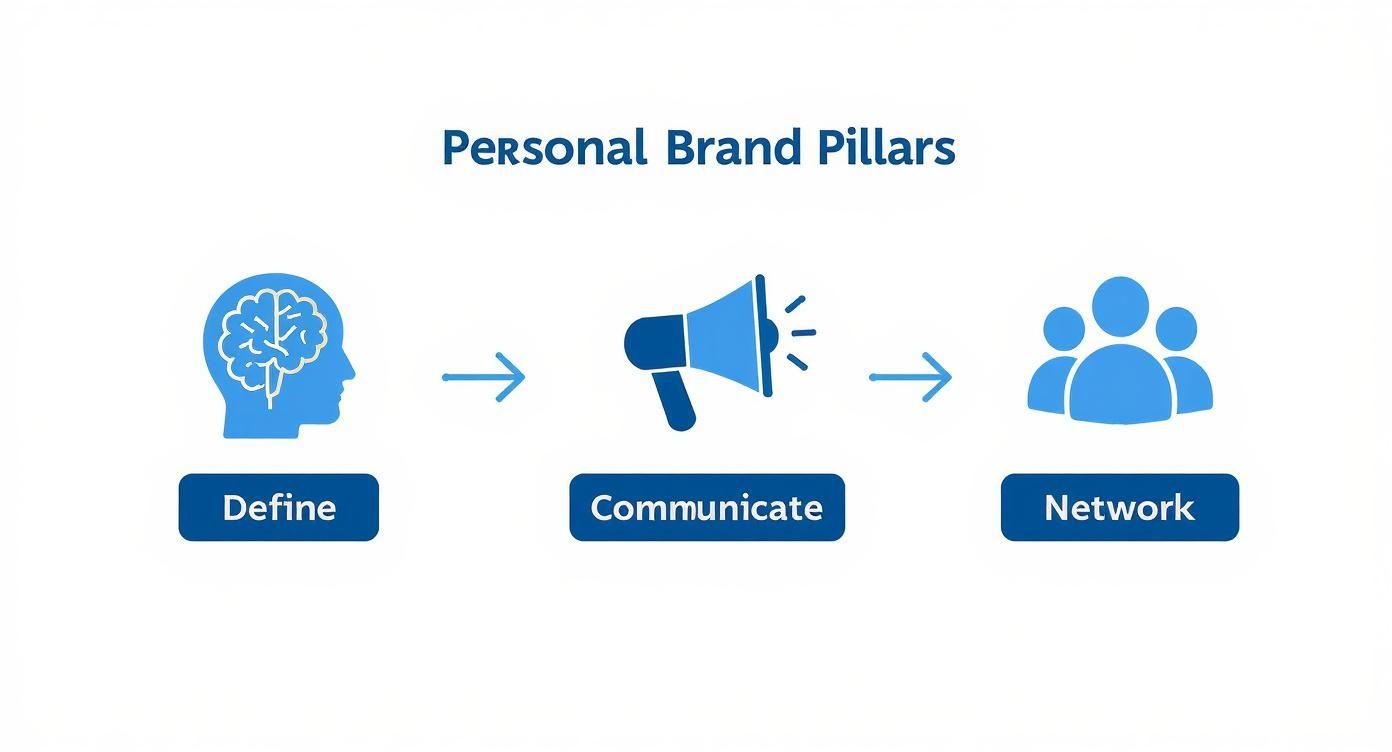
This process isn't complicated. It starts with self-awareness (knowing your expertise), moves into strategic communication (sharing your value), and is powered by genuine connection (networking). This guide will walk you through mastering each step.
Finding Your Authentic Brand Foundation
Before you can even think about posting, you have to get this part right. Building a personal brand that actually means something requires a solid foundation. This isn't about inventing a slick persona or faking it until you make it—it’s about digging deep to figure out what makes you, well, you.
Trying to build a brand without this groundwork is like building a house on sand. It might look impressive for a hot second, but it’ll crumble the moment someone pushes back. Real influence, the kind that lasts, comes from being unapologetically authentic and ethical.

Why Authenticity Is Non-Negotiable
In a sea of perfectly curated highlight reels, people are desperate for something real. Authenticity isn't just a buzzword; it's the bedrock of any successful personal brand because it's how you build trust—your most valuable asset. When your online self mirrors your real self, you forge connections that are both powerful and sustainable.
And this isn't just a feel-good idea. The numbers back it up. A staggering 86% of shoppers say they prefer brands that are authentic and honest, and that sentiment applies just as much to individuals. You can dive deeper into this shift toward brand authenticity on G2.com. People are tired of the polish; they connect with real stories, transparency, and even a bit of vulnerability.
Besides, trying to be someone you're not is flat-out exhausting. When your brand is grounded in who you really are, showing up consistently feels natural, not like you're putting on a performance.
Uncovering Your Core Expertise
Your core expertise is that specific zone where you deliver real, tangible value. You don't need to be the world's number one authority on a topic, but you do need to own a niche where your knowledge can genuinely help people.
To nail this down, ask yourself a few direct questions:
- What problems do people always ask you to solve? This is a massive clue about where others already see your value.
- What subjects do you read about or debate just for fun? Your natural curiosity is a powerful signpost pointing toward your passions.
- Think about your past jobs. Which wins felt the most rewarding? Break down the specific skills you used to make them happen.
- If you had to lead a one-hour workshop tomorrow, what would it be on? This exercise forces you to pick something you know inside and out.
The idea here is to get specific. Don't just settle for "marketing." Drill down to something like "launching affordable SaaS products for early-stage B2B startups." That’s where a unique brand starts to form.
Defining Your Unique Value Proposition
Your Unique Value Proposition (UVP) is what happens when your skills smash right into the needs of a specific audience. It’s the clear, simple answer to the question: "Why should anyone follow, listen to, or hire you over all the other options?"
Your UVP isn't just what you do. It's how you do it, who you do it for, and the unique spin you bring to the table. It's the magic that happens at the intersection of your skills, your passion, and your audience's pain points.
A simple formula can help you craft it:
I help [Target Audience] achieve [Specific Outcome] by using my unique ability in [Your Core Skill/Method].
Let’s see it in action. Instead of a generic "I'm a software developer," a killer UVP sounds like this: "I help non-technical founders build their first minimum viable product (MVP) by translating their vision into clean, scalable, and affordable code." See the difference? It instantly tells you who they serve, the result they deliver, and what makes them the right person for the job.
Identifying Your Target Audience
You can’t build a magnetic brand by trying to be everything to everyone. It just doesn't work. When you speak to a specific group of people, your message hits harder and you position yourself as a specialist, not a generalist.
Your target audience isn't just a demographic. It's a community of people with shared problems, ambitions, and ways of thinking.
Get to know them by considering:
- Their Professional Role: Are they founders? Mid-level managers? Junior devs?
- Their Biggest Challenges: What’s keeping them up at night? What roadblock are they desperate to overcome in their career?
- Their Aspirations: What does success look like in their world? What are they striving for?
Once you understand their world, you can create content that feels like it was written just for them. This focused approach is not only more effective, it’s also the right way to build a brand. You're committing to serve a community you genuinely understand instead of just shouting into the void. This foundation is the first, and most important, step in learning how to build a personal brand that matters.
Building Your Digital Presence on LinkedIn

Now that you've got a handle on your brand's foundation, it's time to build its digital home. For any serious professional, that home is unquestionably LinkedIn.
Forget thinking of your profile as an online resume. It's not static. It’s a dynamic, living landing page for your entire career and the first thing people see when they Google your name. That first impression is everything.
This is where you take the "why" we just figured out and turn it into a digital presence that pulls opportunities toward you. A truly optimized profile does more than just list your jobs; it tells a clear story about the value you bring and exactly who you help. Every piece—from your photo to your headline—needs to work together to broadcast your unique expertise.
Transforming Your Profile Into a Brand Asset
A generic profile is forgettable. A brand-centric profile starts conversations. The mission is to make it dead simple for any visitor—a recruiter, a potential client, a peer—to understand who you are, what you do, and why they should care. That immediate clarity is what builds trust and authority from the first click.
Let's break down the essential pieces and how to sharpen them up.
Your Profile Picture: Think of this as your digital handshake. You need a crisp, high-quality headshot where you look both professional and approachable. No distracting backgrounds, no group shots, and definitely no blurry selfies. It should look like the you that someone would meet for coffee.
The Banner Image: This is the most wasted real estate on LinkedIn. Ditch the default blue banner and create a custom graphic that speaks for your brand. It could feature your core message, a list of your specialties, or even a shot of you in action—speaking or leading a workshop. It’s a small change that makes your profile look intentional and polished.
The Custom URL: By default, LinkedIn gives you a messy URL with a string of random numbers. Cleaning it up to
linkedin.com/in/yournameis a small detail that screams professionalism. Little tweaks like changing your LinkedIn URL to boost your brand have a surprisingly big impact.
These foundational elements set the stage. Now for the words that will do the heavy lifting.
Crafting a Headline That Grabs Attention
Your headline is the single most important piece of text on your entire profile. It shows up everywhere—next to your name in search results, on every comment you leave, and in every connection request you send. It has to do more than just list your job title.
A killer headline telegraphs your value proposition in a split second. A simple but powerful formula to start with is:
[Your Role] | Helping [Your Target Audience] Achieve [Their Desired Outcome]
Let's see what that looks like in the wild.
| Before (Generic & Passive) | After (Value-Driven & Branded) |
|---|---|
| Marketing Manager at ABC Corp | B2B Marketing Manager | Helping SaaS Startups Drive Qualified Leads and Scale Revenue |
The "After" version is a world of difference. It instantly tells visitors who this person helps (SaaS startups) and the concrete result they deliver (qualified leads and revenue). It’s no longer just a title; it’s an active statement of value that brings your brand to life.
Writing an About Section That Tells Your Story
The "About" section is your chance to add color and personality to your headline. Don't just copy-paste your resume summary here. This is where you connect the dots for your audience, weaving your skills, passion, and purpose into a compelling narrative.
Structure it for impact:
- Open with a Hook: Kick things off with a strong sentence that encapsulates your entire value proposition.
- Define Who You Serve: Get specific about your target audience and the problems you solve for them.
- Offer Proof: Mention key achievements or experiences that back up your claims. Use bullet points to make your core skills scannable.
- Show Some Personality: Share what drives you or a core value you hold. This is what makes you relatable and memorable.
- End with a Call to Action: Tell people what to do next. Connect? Visit your website? Send a message? Guide them.
A great "About" section doesn’t just list what you’ve done; it connects the dots for the reader, showing them the common thread that runs through your career and how it benefits them. It’s your brand’s manifesto.
The Art of Strategic Networking
Building a personal brand on LinkedIn isn't a solo sport. Your network is your community, your sounding board, and your pipeline for opportunities. But this isn't about collecting connections like baseball cards. An ethical approach means quality trumps quantity, always.
Take a value-first approach to networking:
- Personalize Every Request: Never, ever send the default "I'd like to connect with you on LinkedIn." A quick, personal note explaining why you want to connect changes everything. Mention a shared interest, something insightful they posted, or a mutual connection.
- Give Before You Get: Look for ways to add value to your network before you ever ask for anything. Share articles they’d find useful, drop thoughtful comments on their posts, or make an introduction if it makes sense.
- Engage for Real: Just 15 minutes a day of genuine engagement makes a huge difference. A thoughtful comment that adds to the conversation is worth a hundred "Great post!" replies.
This kind of consistent, authentic interaction turns a passive list of connections into an active community. And when it comes to managing that activity, it helps to know your options. For instance, comparing tools in a breakdown of Contentide versus Taplio can show you different ways to approach LinkedIn growth. By putting genuine interaction first, you build a presence that not only looks great but delivers real results.
Developing a Realistic Content Strategy
Your content is the engine that drives your personal brand. It’s how you take all that foundational work—your niche, your voice, your unique perspective—and make it visible. This is how you consistently prove your value to your network.
But let's get one thing straight: a winning content strategy isn't about chasing viral hits or dropping a ton of cash on flashy production. It's about finding a sustainable, affordable rhythm that actually works for you.
The goal is simple: show up and provide value, consistently. When you nail that, you build trust and become the go-to person in your field. This section is all about giving you a practical framework to create content that connects, without the overwhelm.

Choosing Your Content Formats
Here’s a secret: you don’t need to master every single type of content out there. The real key is to pick a few formats that play to your strengths and work well on platforms like LinkedIn. For busy professionals, simplicity and affordability are everything.
Here are a few high-impact, low-effort formats to get you started:
- Insightful Text Posts: This is the absolute workhorse of LinkedIn. A simple, well-structured text post sharing a personal story, a hard-won lesson, or a unique point of view can drive serious engagement. The best part? It costs nothing but your time and expertise.
- Simple Carousels: Don't let the word "design" freak you out. Tools like Canva make creating simple, text-based carousels (which show up as PDFs on LinkedIn) incredibly easy. Just break down a complex idea into 5-7 simple slides. This format is super shareable and instantly positions you as a teacher.
- Short, Authentic Videos: Forget about hiring a professional videographer. A 60-90 second video shot on your phone can be insanely powerful. Just prop your phone up, look into the camera, and share one clear, valuable tip. On LinkedIn, authenticity beats high production value every single time.
The idea is to start small. Master one or two of these. Being consistent with a simple format is way more effective than occasionally attempting something complex.
A Simple Framework for Generating Ideas
The dreaded blank page is the biggest killer of consistency. Having a simple framework in your back pocket means you'll have an endless stream of relevant content ideas that tie directly back to your brand.
I like to think of content in four core pillars:
- Educate: Share a "how-to" tip, break down a complicated industry concept, or debunk a common myth. This is pure value.
- Inspire: Tell a personal story about a challenge you overcame. Share a lesson you learned from a failure. Or, highlight a success and the real journey it took to get there.
- Engage: Ask a thought-provoking question about your industry. Run a simple poll to get a pulse on a trend. Share a strong opinion and ask what others think.
- Promote (Sparingly): This is where you can mention a service you offer or a project you're proud of. But use this pillar the least—aim for an ethical 80/20 split between providing value and promoting yourself.
Rotating through these pillars keeps your content fresh and serves your audience in different ways. And remember, a great hook is crucial to grab attention in a crowded feed. If you're stuck, exploring a hook generator can provide inspiration for crafting those vital opening lines.
Creating a Sustainable Content Calendar
Consistency is so much more important than frequency. Posting three times a week without fail is infinitely better than posting daily for one week and then vanishing for a month. A simple calendar helps you stay on track and removes the daily pressure.
A content plan removes the daily stress of "What should I post today?" It lets you be strategic and thoughtful, making sure every piece of content builds toward your bigger personal branding goals.
To make this tangible, here's a practical template for a weekly content plan that won't burn you out. It’s designed to help you stay consistent without feeling overwhelmed.
Sample Weekly LinkedIn Content Calendar
| Day | Content Theme | Example Post Idea |
|---|---|---|
| Monday | Inspire (Personal Story) | "Last year, we missed a major deadline. Here are the 3 uncomfortable lessons I learned about leadership from that failure." |
| Wednesday | Educate (How-To) | "Struggling with project scope creep? Here's the exact 4-step process I use to keep clients and projects on track." |
| Friday | Engage (Question/Opinion) | "AI is changing my industry in X way. I'm both excited and concerned. What's the biggest impact you're seeing?" |
This schedule is totally manageable. It gives you a nice mix of content types and keeps the focus squarely on delivering genuine value. The real secret is to "batch" your content creation—spend an hour or two on a Sunday afternoon writing these three posts, then schedule them. That simple system is how you build a powerful personal brand without the burnout.
Growing Your Network Through Genuine Engagement
Creating content is only half the battle. Your personal brand isn't built when you hit "post"—it's forged in the conversations happening in the comments and replies.
This is where the real work happens. Genuine engagement is the single best way to turn a passive audience into a community that actually trusts you. It's how you show up as a real person, not just a content machine.
The Power of Small, Consistent Actions
You don’t need to live on LinkedIn for hours every day. The secret is small, deliberate actions, repeated consistently. These tiny efforts compound over time, dramatically boosting your visibility and authority.
Think of it less as a chore and more as a daily practice. You're showing up for your professional community, giving value before you ever expect to get anything back. Over time, these small acts of connection transform your network from a list of names into a web of real relationships.
Engagement is the act of showing up for others. When you thoughtfully contribute to someone else's conversation, you not only provide value but also introduce your expertise to a new, relevant audience.
Actionable Strategies for Meaningful Engagement
Forget the generic "Great post!" comments. And please, don't use automation tools that just spam people—it’s an ethical shortcut that’s a fast track to losing trust. Real engagement takes a bit of thought, but the payoff is massive.
Here’s how to do it right:
Respond Thoughtfully to Every Comment: Someone took time out of their day to comment on your post. Honor that. Ask a follow-up question, expand on their point, or thank them for a specific insight they shared. This simple act can double your post's reach and shows your audience you're actually listening.
Add Value to Industry Conversations: Block out 15 minutes every single day to find posts from other interesting people in your field. Leave a comment that adds a new perspective, shares a helpful resource, or even offers a respectful counterpoint. This is how you get on the radar of the right people.
Use Feedback to Fuel Your Content: Pay attention to the questions people ask in your comments and DMs. These aren't just questions; they're content gold. Each one is a direct signal of what your audience is struggling with, giving you the perfect idea for your next high-value post.
By focusing on these authentic practices, you build a reputation as someone who is not just knowledgeable, but also generous and approachable. That’s the foundation of a brand that people respect and remember.
Monetizing Your Brand Without Selling Out
So, you've built an audience and established yourself as an expert. The natural next step is turning that influence into income. But this is where a lot of personal brands go wrong.
The moment you start pushing get-rich-quick schemes or shady products, you destroy the trust you've worked so hard to build. Monetization has to be an authentic extension of your brand—it should never feel like you're "selling out."
The key is to avoid chasing the mass market. Instead, the most sustainable (and ethical) way to earn an income is by serving a specific micro-niche. Find a small, dedicated group of people, understand their unique problems, and create targeted, affordable solutions just for them.
Pathways to Ethical Monetization
When you start small and focus on a niche, you build an income stream rooted in genuinely helping people. Your financial success becomes a direct result of the value you provide, keeping your brand's integrity completely intact.
Here are a few practical, low-cost ways to get started:
- Consulting Services: Offer one-on-one sessions to help people solve a specific problem you’re an expert in.
- Small Workshops: Host a paid, intimate online workshop on a topic your audience is always asking about.
- Affordable Digital Products: Create a simple ebook, a handy template, or a guide that solves a common pain point for a small price.
- Affiliate Marketing: This one's tricky. Choose ethics: only promote tools or resources you actually use and believe in. Your recommendation needs to feel like a genuine extension of your expertise, not a random ad.
This micro-niche model is really taking off. Platforms like Substack and Patreon have made it incredibly easy to serve hyper-specific audiences with memberships and exclusive content. It all comes back to a deep understanding of your audience's unique challenges and goals. For a deeper dive, Chris Ducker has some fantastic insights on the future of personal brand monetization.
The most ethical monetization strategy is simple: solve a real problem for a specific group of people. When you focus on service, the income becomes a natural byproduct of the trust and value you’ve created.
Common Questions About Personal Branding
Even with a solid plan, a few nagging questions and a dose of self-doubt are bound to pop up. It’s completely normal. Let’s tackle some of the most common mental roadblocks head-on.
How Much Time Do I Really Need to Invest?
Consistency beats intensity, every single time. You don’t need to chain yourself to your desk for hours every day.
Aim for 3-4 hours per week. Spend about half that time creating and scheduling your posts, and the other half on real, human engagement. That means replying to comments, jumping into other people's conversations with valuable insights, and building relationships. Starting small and sticking with it is the only way to see real growth without burning out.
What if I Feel Like an Imposter?
Welcome to the club. Seriously. That little voice telling you that you have nothing unique to say is just imposter syndrome, and pretty much everyone deals with it. Your value isn't about being the #1 expert on the planet.
Your uniqueness comes from your specific blend of skills, experiences, and perspective. You just need to be one step ahead of the people you're trying to help. Your journey itself is the value.
Can I Build a Brand Without Showing My Face?
It’s possible, but it's playing on hard mode, especially on a platform like LinkedIn where trust is everything. A professional headshot is the fastest way to build that initial connection.
If you go the anonymous route, you'll need to lean heavily on a super-distinctive writing style, the sheer quality of your insights, or a memorable logo. But for a truly "personal" brand, a clear photo adds a layer of authenticity that's tough to replicate. For more on content strategy and standing out, you can find a ton of practical tips over on the Contentide blog.
Stop staring at a blank page and start building your brand. Contentide uses AI to help you turn your ideas into authentic, high-performing LinkedIn posts in minutes. Try it for free.
Hope you found this helpful. Feel free to share your thoughts.