How to Find Your Target Audience Ethically and Affordably
Learn how to find your target audience with our practical, budget-friendly guide. Discover ethical strategies to connect with your ideal customers.

Figuring out how to find your target audience can feel like an expensive, complicated guessing game. Most guides jump straight to costly software and invasive data mining, which is overwhelming if you're a small business or just starting out.
But here's the truth: you don't need a massive budget or creepy tracking to understand who your ideal customers are. You can build a powerful strategy by focusing on genuine connection, ethical methods, and affordable tools first.
Building an Ethical and Affordable Audience Strategy
The most effective, long-lasting strategies are built on respect and affordability. This means you prioritize listening over data harvesting and aim for real connection instead of just chasing conversion metrics. It’s a commitment to providing an affordable product that genuinely serves people, not just targets them.
When you shift your perspective this way, you're not just finding customers; you're building a loyal community that genuinely wants to hear from you.

Why This Approach Actually Wins
Choosing an ethical path isn’t just about doing the right thing—it’s just plain smart business. People are more aware than ever about how their data is used. In fact, 80% of consumers say they want more personalized experiences, but that desire comes with a huge expectation of transparency and respect.
An ethical strategy builds that trust from day one. By focusing on listening and providing real value, you create a positive feedback loop that naturally attracts the right people and gives them a reason to stick around.
It's also way more affordable. Instead of paying for access to broad, impersonal datasets, you're investing your time in understanding the people who already see value in what you offer. This is how you can provide an affordable product—by cutting waste and focusing on what truly matters.
This approach really boils down to a few core ideas:
- Listen First: Your current customers are your single greatest source of information. Pay close attention to their feedback, their questions, and the language they use.
- Prioritize Connection: Try to understand the human behind the data point. What are their real-world challenges and goals? What keeps them up at night?
- Use Free & Affordable Tools: You can get incredible insights from social media analytics, free survey tools, and public forums like Reddit or Quora without spending a dime.
- Respect Privacy: Be upfront about what information you collect and why. We take this seriously, and you can see our commitment in action by reviewing Contentide's privacy policy.
This isn't about finding people to sell to. It's about finding the people you can best serve. When you shift your mindset from extraction to service, your entire marketing strategy becomes more authentic and a whole lot more effective.
The Ethical Audience Discovery Framework
To make this practical, I've put together a simple framework. It summarizes the core principles for finding your audience in a way that’s both ethical and budget-friendly.
| Principle | Ethical Approach | Affordable Tactic |
|---|---|---|
| Start with Empathy | Focus on understanding real problems before offering solutions. | Conduct 3-5 informal interviews with existing customers or connections. |
| Build on Trust | Be transparent about data use and prioritize user consent. | Use simple, free survey tools like Google Forms and clearly state your purpose. |
| Provide Value First | Offer useful insights and resources with no strings attached. | Analyze public conversations on Reddit or LinkedIn to find common questions and answer them. |
| Iterate with Feedback | Use direct feedback to refine your audience profile, not just data. | Create a small, private feedback group (e.g., a Slack channel or email list) for your most engaged users. |
This framework isn't about complicated analytics; it's about being human. By rooting your strategy in these simple, respectful practices, you build a stronger, more sustainable connection with the people who matter most to your business.
Uncover Insights from Your Existing Customers
Before you go chasing expensive market research or complex ad campaigns, take a look at the goldmine sitting right in front of you: your existing customers. These are the people who already see value in what you do.
Figuring them out—really understanding them—is the smartest, cheapest, and most effective way to start defining your broader target audience.

Starting here isn't about guesswork. It's about groundwork. You're not inventing some imaginary "ideal customer." You're getting to know the real people who are already on your side, building your strategy on a foundation of real data.
Dig into Your Website and Social Analytics
Your digital platforms are swimming with behavioral data that shows you who your audience is and what they care about, all without getting creepy. The goal isn't to spy on individuals, but to spot broad, anonymous patterns.
First, pop open your website analytics. Most platforms, like Google Analytics, have demographic reports that give you a high-level snapshot of the aggregate age, gender, and general interests of your visitors. It’s a great starting point.
Next, check your social media insights. Platforms like LinkedIn, Instagram, and Facebook serve up analytics on your followers—their locations, job titles (a huge plus on LinkedIn), and age ranges. Pay close attention to the posts that get the most love. That’s a direct signal of what topics are hitting home.
- Website Traffic: What are your top-performing blog posts or pages? Is there a common thread or a specific problem they all solve?
- Social Engagement: Look at the posts with the most comments and shares. What questions are people asking? What conversations are happening?
- Follower Demographics: Note the most common age brackets, locations, and (for LinkedIn) industries of your followers.
This initial sweep won't give you the whole story, but it absolutely points you in the right direction. For instance, if you see that 70% of your LinkedIn engagement is coming from marketing managers in the tech industry, you’ve just found a massive clue.
Your analytics tell you what your audience does, but they don't tell you why. The "what" is where you start. The "why" is where the real magic happens.
Craft Ethical and Insightful Surveys
To get to that "why," you just have to ask. Surveys are a brilliant, low-cost way to gather direct feedback. With free tools like Google Forms or Typeform, you can create simple, respectful surveys that get to the heart of your audience's challenges and motivations.
The trick is to ask open-ended questions. You want stories, not just "yes" or "no" answers. You’re trying to understand their world, not just how they feel about your product.
Questions That Uncover True Motivations
Forget the generic stuff. Focus on their journey and their struggles. Here are a few questions I’ve found that get truly meaningful responses:
- "Before you found us, what was the biggest headache you faced with [the problem you solve]?" This gets right to the pain point that sent them looking for a solution in the first place.
- "What specific outcome were you really hoping for when you signed up?" This uncovers their goals, which are often much more powerful than any single feature.
- "Think about a time our product was a lifesaver. What were you trying to get done?" This gives you real-world scenarios and context for where you provide the most value.
- "What other things did you try before this? What drove you crazy about them?" This is pure gold for competitive insights, showing you exactly what makes you different from their perspective.
When you send the survey, be upfront. Tell them how long it will take and what you’ll do with the feedback. A small incentive can boost response rates, but you'll often find your best customers are more than happy to help for free.
By layering the quantitative data from your analytics with these rich, qualitative insights from surveys, you start to build a remarkably clear picture of who you're serving. It's a customer-first approach that not only gives you better data but also builds trust.
Crafting Customer Personas That Feel Real
You’ve dug through your analytics and gathered a ton of direct feedback. Awesome. Now you're sitting on a pile of raw data, which is where most marketers hit a wall. But this is where the real work—and the real magic—begins. It’s time to turn those spreadsheets and survey responses into something human, something your team can actually connect with.
This is how we're going to build customer personas. But let's be clear: forget those sterile, corporate templates you've seen a thousand times. We aren't just listing job titles and income brackets. A truly useful persona is a narrative, a story about a real person with goals, frustrations, and motivations that drive them every single day.

This whole process is about weaving together the what from your analytics with the why from your customer interviews. Get this right, and your personas become the north star for everything you do, from product development to content creation.
From Data Points to Human Stories
The goal here is to create a one-page snapshot that feels like you're describing a friend. It sounds simple, but you have to start by giving your persona a name. Call her "Startup Founder Sarah" or "Freelance Consultant Frank." It immediately makes them more relatable than "Audience Segment B."
Next, pull the most compelling quotes directly from your survey responses. Did someone describe your product as a "lifesaver" during a chaotic project launch? Use that exact language. It’s authentic and carries an emotional punch that a summarized bullet point never could.
From there, you can start building out the core of their story:
- Goals: What are they trying to achieve professionally or personally? What does success actually look like in their world?
- Pain Points: What are the recurring frustrations that get in their way? Use their own words to describe these headaches.
- Values & Motivations: What really drives their decisions? Is it about efficiency, or are they motivated by ethics and affordability?
- Watering Holes: Where do they hang out online to learn and connect? Get specific—think certain LinkedIn groups, niche subreddits, or must-read industry newsletters.
A great persona doesn’t just list facts; it tells a story. It answers the question: "What is a day in this person's life actually like?" That level of empathy is the foundation of marketing that truly connects.
A Flexible Persona Framework
Instead of getting locked into a rigid template, think of this as a flexible framework. Your main focus should be on the psychographics—the why behind their behavior—far more than just their demographics.
| Persona Element | Guiding Question | Example for "Startup Founder Sarah" |
|---|---|---|
| Primary Goal | What's the main outcome they're striving for? | "Secure the next round of funding by showing consistent growth." |
| Biggest Challenge | What keeps them up at night? | "Juggling product development, sales, and marketing with a tiny team." |
| Core Motivation | Why do they do what they do? | "To build something from the ground up that solves a real problem." |
| Key Quote | What did a real customer say that captures this persona? | "I don't have time for complex tools. I need something that just works." |
Understanding these deeper elements is everything. For instance, knowing Sarah values simplicity means you won’t try to sell her on a dozen complex features. Instead, you'll talk about how your tool saves her precious time.
If you're looking to sharpen this process, a resource like Modern B2B Prospecting: Your Ultimate Guide is a goldmine for building a razor-sharp Ideal Customer Profile, which is the perfect foundation for these personas.
Weaving in Demographic Realities
Psychographics give your persona a soul, but demographics provide the context needed to find them in the real world. Age, for example, is a huge factor in platform preference.
If you're targeting decision-makers, knowing that millennials (aged 29-44) are the largest U.S. demographic on LinkedIn at 35.8% is a game-changer. Globally, the 25-34 age group absolutely dominates LinkedIn, making up 47.3% of its audience. This tells you that your content for "Startup Founder Sarah" needs to be built for that platform.
When you combine these demographic facts with the persona’s story, your targeting becomes incredibly precise. You know who Sarah is and exactly where to find her. This makes sure your marketing is both empathetic and efficient.
With these living, breathing personas in hand, you’re ready to create content that speaks directly to their world. You might find our guide on crafting better content hooks especially useful for grabbing their attention.
Low-Cost Research Methods for Audience Discovery
Figuring out who your audience is doesn't have to cost a fortune. You don't need enterprise software or a six-figure research budget to get started. In fact, some of the most powerful insights are hiding in plain sight, waiting in the conversations already happening online.
This is about listening, not interrupting. By ethically observing your market in its natural habitat, you can uncover a goldmine of qualitative data without spending a dime. It's the perfect approach for startups and small businesses who need to build an audience strategy on a foundation of genuine understanding.
Become a Digital Eavesdropper on Social Media
Your competitors have already done a ton of the heavy lifting for you. Their social media channels are basically public case studies on what resonates with your shared potential audience.
Start by picking three to five direct competitors. Don't just glance at their follower count; that's a vanity metric. The real value is buried in the comment sections of their most popular posts. What kind of language do people use? What questions keep popping up? Are there recurring complaints or feature requests that go unanswered?
This isn't about swiping their ideas. It's about getting a feel for the market's pulse. For instance, if you see a competitor's audience constantly asking for a certain tutorial that the competitor never delivers, you’ve just stumbled upon an unmet need.
Pay close attention to the emotions in the comments. Frustration, excitement, and confusion are all powerful signals that point directly to customer pain points and desires. This is the raw, honest feedback that paid surveys often miss.
Don't stop at direct competitors. Look at industry influencers and complementary brands, too. See who they attract and what topics get people talking. This helps you map out the entire ecosystem your audience lives in.
Mine Customer Reviews for Unfiltered Truths
Customer reviews are another treasure trove of brutal honesty. People rarely hold back when talking about a product or service they paid for, which makes sites like G2, Capterra, or even Amazon fantastic sources of information.
Make sure to look at both the glowing five-star reviews and the scathing one-star takedowns for products similar to yours.
- Five-star reviews often pinpoint the "aha!" moment or the one feature that made a customer fall in love with a solution. This tells you exactly what you should be emphasizing in your own messaging.
- One-star reviews are arguably even more valuable. They expose common frustrations, deal-breakers, and critical gaps in the market just waiting to be filled.
Let's say you're building a new project management tool. If you read dozens of reviews for a competitor that complain about a "clunky" and "confusing" interface, you've just discovered your key differentiator. You can win by focusing on simple, intuitive design—all without running a single focus group.
Tune into Niche Online Communities
Platforms like Reddit and Quora are where people go for authentic conversations, far from the polished world of LinkedIn or Instagram. These communities are neatly segmented by interest, making it easy to find your people.
Search for subreddits (like r/marketing, r/freelance, or r/startups) or Quora topics related to your industry. Once you're in, your only job is to listen.
- Observe the Language: How do they describe their problems? What slang or acronyms are common? Speaking their language is how you build instant credibility.
- Identify Common Questions: Look for threads starting with "How do I..." or "Does anyone else struggle with..." These are direct signposts to valuable content ideas and potential product features.
- Spot Unmet Needs: Keep an eye out for what people wish existed. You’ll often find comments like, "I wish there was a tool that could just do X," which is pure gold for innovation.
This kind of "social listening" is deeply ethical because you're just a passive observer of public conversations. You aren't collecting personal data; you're learning from the community. Of course, listening is just the first step. To turn these insights into a real audience, you’ll need practical strategies like learning how to build email lists that grow your business. When you combine sharp observation with smart, permission-based tactics, you create a growth engine that can last.
Using LinkedIn for Precision Audience Research
For anyone in the B2B space, LinkedIn is so much more than a digital resume or networking site—it’s an ethical, low-cost research machine. The platform’s public data gives you a direct window into your ideal customer's professional world, letting you see their roles, challenges, and conversations firsthand.
This isn't about spamming inboxes or hitting people with aggressive sales pitches. It’s about observation. By exploring the platform with a researcher’s mindset, you can build an incredibly detailed picture of the people you want to serve.
Master Advanced Search for Audience Segmentation
LinkedIn’s search bar is your most powerful free tool for this kind of discovery. Forget just typing in names—the real magic is in the advanced filters. This is how you move from a vague idea of your audience to a clear, data-backed profile.
Start segmenting your potential audience with a few critical professional filters. Think about the personas you've already sketched out and use these to find real people who fit the mold.
- Job Title: Are you aiming for "Marketing Managers," "Software Engineers," or "Chief Financial Officers"? The more specific, the better.
- Industry: You can filter for professionals in "Information Technology," "Healthcare," or "Financial Services" to narrow your focus.
- Company Size: Is your ideal customer at a tiny startup (1-10 employees) or a huge corporation (10,001+ employees)? This detail matters.
- Location: Pinpoint people in specific cities or countries that are relevant to your market.
When you combine these, you can get hyper-specific. For instance, you could quickly identify "Product Managers in the SaaS industry at companies with 51-200 employees located in Austin, Texas." Suddenly, your abstract audience becomes a tangible group of professionals.
Analyze Content and Conversations in LinkedIn Groups
Think of LinkedIn Groups as virtual water coolers. They're where professionals in your niche gather to talk about trends, ask for advice, and share what's working. Joining a few relevant groups gives you an ethical "fly-on-the-wall" perspective.
Your goal here is simple: listen, don't sell. What questions keep popping up? Are members constantly complaining about a specific type of software? Are they looking for better ways to manage their teams? These conversations are pure, unfiltered gold.
By observing the language and pain points discussed in these groups, you gain direct insight into the market's needs. This is where you'll find the exact phrasing your audience uses, which is priceless for crafting marketing messages that truly resonate.
This visualization breaks down how to approach low-cost research by zeroing in on a few key areas.
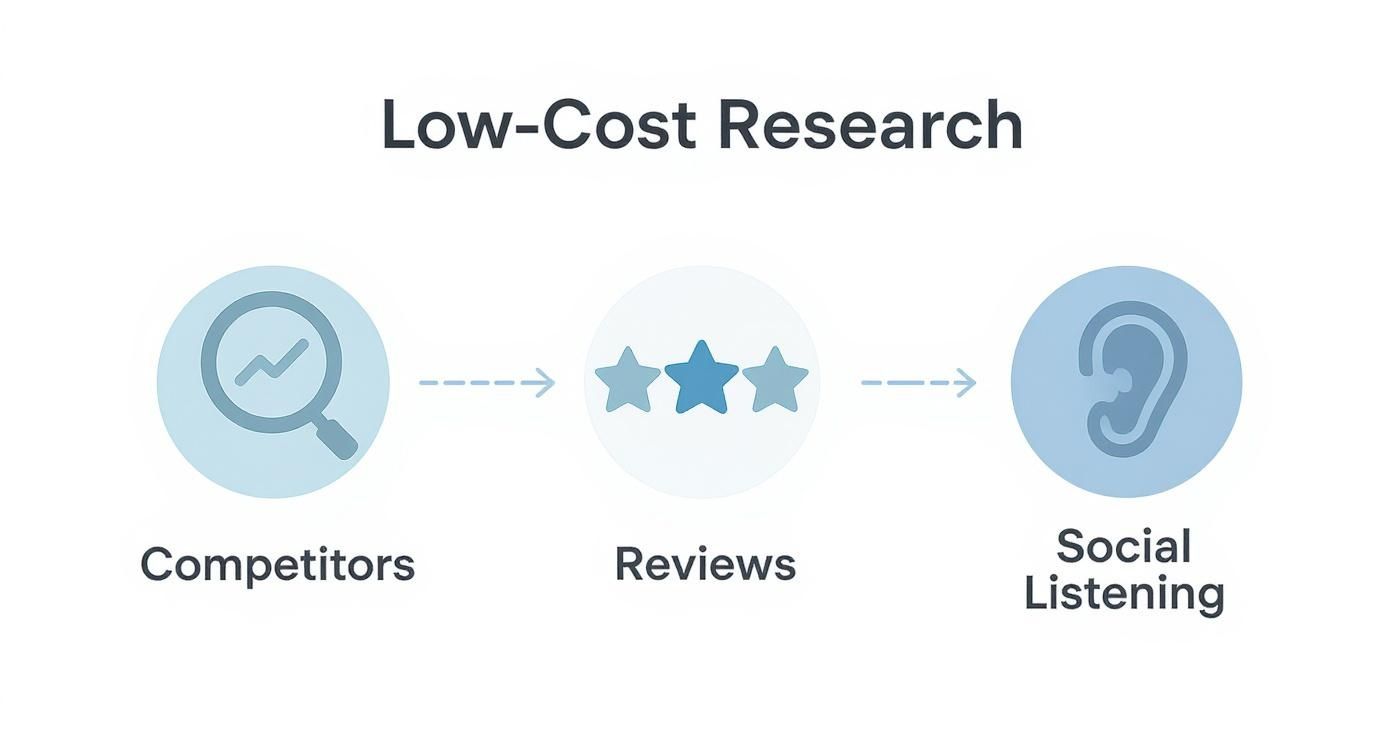
As the flowchart shows, digging into competitors, customer reviews, and social media chatter are all incredibly effective ways to gather audience data without a big budget.
Study Competitors and Industry Leaders
Another smart, no-cost tactic is to simply look at your competitors' LinkedIn pages. Check out who is commenting on their posts and what topics get the most engagement. This tells you exactly who they are successfully attracting.
Do the same for key industry leaders and influencers your target audience probably follows. The people engaging with their content are almost certainly part of your ideal customer base. Studying these discussions can reveal emerging trends and pain points you might have missed. For those wanting to speed this up, a comparison of LinkedIn growth tools like Taplio can show you how automation helps with content analysis.
Don't forget about geography, either. Knowing where your audience lives and works is crucial. For instance, the United States leads with 200 million LinkedIn users, followed by India at 99 million. This shows that while established markets are huge, emerging ones like India and Brazil present massive growth opportunities that might need a totally different approach.
This whole process—analyzing search results, group discussions, and competitor activity—gives you a rich, multi-layered understanding of your audience. It's an ethical, effective approach that grounds your strategy in real, publicly available data.
Got Questions? Let's Talk Strategy.
It's one thing to read a guide, but another thing entirely to apply it. When you get down to the nitty-gritty of finding your audience, a few common roadblocks always seem to pop up. Let's tackle them head-on.
What If I'm Starting From Absolute Zero? No Customers, No Data, Nothing.
This feels like a disadvantage, but I actually think it's the opposite. Starting from scratch means you have no bad habits or assumptions to unlearn. It forces you to listen to the market from day one, which is an incredible advantage.
Your first move isn't to invent an audience—it's to find where they're already talking.
Identify three to five companies you admire who are already serving the kind of people you want to reach. Then, just listen.
- Dive into the comments on their LinkedIn posts.
- Scour customer reviews on platforms like G2 or Capterra. What do people love? What do they complain about?
- Lurk in relevant Reddit threads or professional groups. Don't post, just read.
You're looking for patterns. Notice the specific words people use to describe their frustrations and goals. This is pure gold—a rich source of qualitative data you can use to build your first draft of a customer persona, long before you make your first sale.
Starting with zero data is a powerful position. It forces you to build your strategy on real, observed needs, not just your own assumptions.
My Audience Feels Way Too Broad. How Do I Get Specific?
I hear this all the time. "My audience is small business owners." Okay, which ones? The bootstrapped freelancer or the founder who just raised a $5 million seed round? They are worlds apart. "Everyone" is the fastest path to connecting with no one.
If your audience feels too broad, you need to stop thinking about who they are (demographics) and start focusing on what they're going through (psychographics).
Take "small business owners." Let's get specific:
- Maybe it's "Early-stage founders overwhelmed by trying to be the entire sales and marketing department."
- Or, "Service-based entrepreneurs who know they need to create content but can never find the time."
- It could even be, "Small business owners who need simple, affordable tools because they can't afford a complex, enterprise-level software suite."
See how much more powerful that is? A good test is to ask yourself: "Can I vividly describe a day in this person's life?" If the answer is no, you need to keep digging deeper.
How Can I Actually Test This Without Blowing a Ton of Cash?
Validation doesn't mean you need to commission an expensive market research study or run a massive ad campaign. You can get real, actionable feedback on a shoestring budget by creating what I call a Minimum Viable Offer (MVO).
An MVO is a small, low-risk piece of value you put in front of your assumed audience to see if they'll actually bite. It's a real-world experiment.
Here are a few ways to do it cheap:
- Spin Up a Simple Landing Page: Use a tool like Carrd to quickly build a one-page site that describes what you plan to offer. You can run a tiny, hyper-targeted ad campaign—even $50 is enough to see if people are interested enough to join a waitlist.
- Offer a Freebie: Create a simple checklist, a useful template, or a short PDF guide that solves one specific, painful problem for your target persona. Share it in those online communities you've been observing and see who raises their hand.
- Run 'Problem' Interviews: This is my favorite. Reach out to five people you believe fit your ideal profile. Ask for 15 minutes of their time—not to pitch them, but to learn about their challenges. This direct feedback is one of the most valuable, low-cost validation tactics on the planet.
Ready to stop guessing and start connecting with your ideal audience on LinkedIn? Contentide is an AI-powered content generator that helps you create authentic, high-performing posts in minutes. Build your professional brand and attract the right followers without the stress of the blank page. Discover how Contentide can transform your content strategy today.
Hope you found this helpful. Feel free to share your thoughts.