A Guide to Writing LinkedIn Articles That Build Authority
Learn how writing LinkedIn articles can build your brand and authority. This guide offers proven strategies for creating content that engages professionals.

Writing LinkedIn articles isn't just another content marketing tactic; it's a powerful way to build your professional brand and prove you know your stuff. It transforms your profile from a static resume into a living, breathing platform where you can share real insights, establish yourself as an authority, and connect with your professional world on a much deeper level.
Best of all, it's an honest, affordable approach that simply relies on sharing what you already know to create incredible opportunities.
Why Writing LinkedIn Articles Is Your Career Superpower

Think of it this way: your LinkedIn profile is your resume, but an article is your chance to give the keynote speech. It’s where you stop listing job titles and start showing people how you think, how you solve problems, and how you see the future of your industry. This is how you build a genuine, memorable professional presence.
When you consistently put out high-value, ethical content, you do more than just fill your feed—you start attracting real opportunities. Recruiters, potential clients, and future collaborators are all looking for experts who can offer clear, insightful perspectives.
Build Authority and Trust
Sharing what you know is far more convincing than just listing skills on a profile. When you consistently publish thoughtful articles, you’re not just broadcasting information; you're building trust with your network. Bit by bit, you position yourself as the go-to person in your field.
In fact, one of the most direct benefits of publishing valuable content is learning how to become a thought leader in your niche. You don't need fancy tools or an expensive product, just a commitment to sharing your unique point of view ethically.
Gain Outsized Visibility
The opportunity on LinkedIn right now is huge, mainly because most people just don't create long-form content. While the platform has over 1 billion members, only a tiny fraction—about 3 million users—share original content each week.
Here’s the kicker: those few creators generate a staggering 9 billion impressions. The math is simple: people who take the time to write get seen. A lot.
Your unique perspective is your greatest asset. While thousands of people might share your job title, nobody has your exact mix of experiences, failures, and wins. Writing articles is how you turn that one-of-a-kind viewpoint into a serious career advantage.
Ultimately, writing articles on LinkedIn is an investment in your personal brand that pays off in visibility, credibility, and connections you haven't even thought of yet.
Before you ever type a single word, the best LinkedIn articles are already taking shape. Great content doesn't just happen by accident; it’s a deliberate answer to a real question or challenge your audience is wrestling with. Forget guessing games. The real magic starts when you pinpoint the actual problems your network is trying to solve.
Who are you writing for, really? Is it a founder drowning in fundraising spreadsheets? Maybe it's a marketing manager baffled by a new analytics dashboard? Get laser-focused on their specific pain points. Your best article ideas are hiding in plain sight—in the questions you get asked in meetings, in DMs, and even in the comment sections of other posts.
Find Your Unique Angle
Once you've locked onto a problem, your next job is to find a perspective that only you can bring to the table. The world doesn’t need another generic listicle. The entire point of writing on LinkedIn is to blend what you know about your industry with what you've lived through personally. That’s how you create a point of view that cuts through the noise.
Need some ideas to find that unique angle?
- Play the Contrarian: Ethically challenge a popular belief in your industry.
- Tell Your Story: Share a personal failure or a hard-won success that taught you something crucial.
- Connect the Dots: Take a new statistic or trend and explain what you think it really means for the future.
This is the stuff that turns a decent topic into a must-read article. It shows you're not just a reporter; you're an expert with valuable, original insights.
Every professional has a unique library of experiences, failures, and “aha” moments. Your best content lives at the intersection of what your audience needs to know and what you're uniquely qualified to teach them. Don't just share facts—share your wisdom.
Outline for a Logical Flow
You’ve got your topic and your unique take. The last step before writing is to sketch out a quick outline. This isn’t about creating a rigid, formal structure; it's about building a clear path for your reader to follow so they don't get lost. A simple outline is your best defense against rambling.
Start with the one thing you want your reader to walk away with. What's the core message? Then, jot down the key points that back it up. For example, if your article is about "Common Mistakes in Project Management," your roadmap might look something like this:
- The Hook: Kick things off with a relatable story about a project going completely off the rails.
- Mistake #1: Lack of clear communication. Give a quick, punchy example.
- Mistake #2: Unrealistic timelines. Explain the disastrous consequences.
- The Solution: Offer two simple, actionable tips for better project planning.
- The Wrap-Up: Briefly summarize the main takeaway and end with a question to get the conversation started.
This simple framework saves you from the agony of staring at a blinking cursor. It turns a fuzzy idea into a clear, actionable plan, ensuring every article you hit "publish" on is strategic, purposeful, and ready to make an impact.
Crafting Compelling Articles People Actually Want to Read
With a solid plan in hand, it's time to get down to the actual writing. Writing for LinkedIn is a unique beast—it's not a formal business report, but it's not a casual social media update either. You're aiming for that sweet spot: professional authority blended with conversational warmth. The goal is to make complex ideas feel simple and, most importantly, relatable.
This is where storytelling becomes your secret weapon. Don't just list facts or dole out generic advice. Instead, wrap your insights in a real-world scenario. A personal story about a project that went sideways or a tough client negotiation is far more memorable than a list of abstract "dos and don'ts." It proves you've been in the trenches and builds an instant connection with your reader.
Think of it as a simple, three-part flow: know your audience, do your homework, and build your structure.
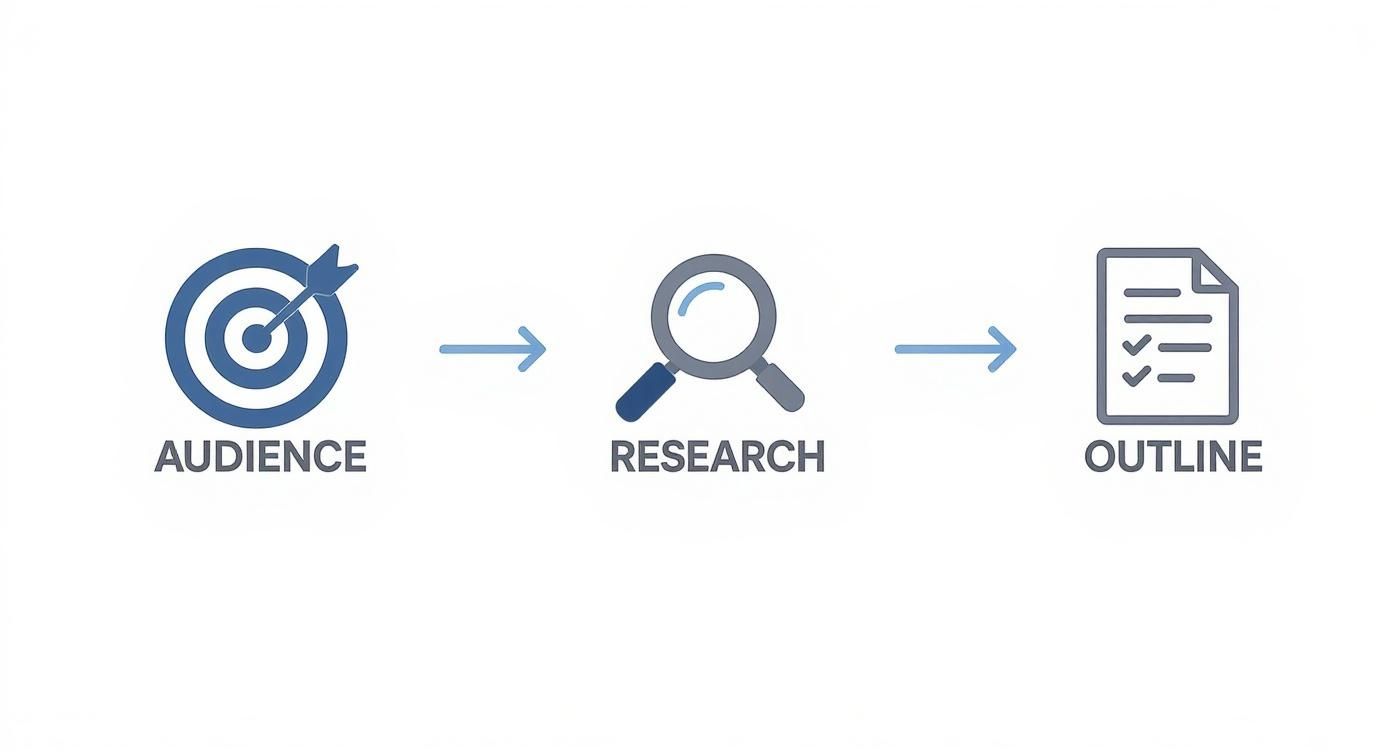
Following this process ensures every article you write is laser-focused on your reader's needs before you even type the first word.
Writing an Introduction That Hooks
You have just a few seconds to grab someone's attention. Your headline gets them to click, but it's your first couple of sentences that make them stay. A powerful opening isn't just nice to have; it's non-negotiable. It has to be punchy, relevant, and promise immediate value.
Forget sleepy introductions like, "In this article, I will discuss..." That's a surefire way to get someone to click away. Instead, dive right into the heart of the problem with something that makes them sit up and take notice.
- Ask a provocative question: "What if your entire approach to team management is wrong?"
- Share a surprising statistic: "More than 70% of professionals admit they struggle with this one simple task."
- Start with a relatable story: "I’ll never forget the moment I realized my biggest client was about to walk."
A great opening makes a promise to the reader that their time will be well spent. If you need some more inspiration, our guide on crafting irresistible hooks can help you brainstorm some powerful article starters.
Your headline makes a promise, but your introduction proves you can deliver. Hook your reader with empathy by showing you understand their exact challenge, and they’ll stick around for the solution you’re about to provide.
To help you stay on track, here’s a quick rundown of the essential components that make a LinkedIn article truly shine.
Key Elements of a High-Performing LinkedIn Article
This table summarizes the core components to include in your articles for maximum impact.
| Element | Best Practice | Why It Works |
|---|---|---|
| Compelling Headline | Use numbers, ask questions, or make an honest promise. Keep it under 70 characters. | Grabs attention in a crowded feed and clearly communicates the article's value. |
| Strong Hook | Start with a surprising stat, a relatable story, or a thought-provoking question. | The first 1-2 sentences determine if the reader continues. A strong hook is critical. |
| Scannable Structure | Use short paragraphs, subheadings, bullet points, and bold text. | Makes the article easy to digest on any device and helps readers find key information quickly. |
| Authoritative Tone | Write conversationally, like you're advising a colleague. Use "I" and "you." | Builds trust and rapport, making your expertise feel more approachable and authentic. |
| Actionable Advice | Provide clear, practical steps or takeaways the reader can apply immediately. | Readers are looking for solutions. Actionable content provides tangible value and positions you as an expert. |
| Strategic Visuals | Include at least one relevant image, chart, or infographic to break up the text. | Visuals improve comprehension, increase engagement, and make the content more shareable. |
| Clear Call-to-Action | End by asking a question, inviting comments, or directing them to another resource. | Guides the reader on what to do next, encouraging engagement and extending the conversation. |
Nailing these elements consistently will set your articles apart and help you build a loyal readership.
Maintaining a Conversational Yet Authoritative Tone
The best LinkedIn articles sound like a chat with a trusted mentor—they're knowledgeable but not arrogant. The easiest way to achieve this is to write like you speak to a respected colleague. Use personal pronouns like "you" and "I" to create a direct, one-on-one connection.
This approachable style doesn't mean you have to sacrifice credibility. You can—and should—weave in data and expert insights, but do it naturally. For instance, it's worth noting that LinkedIn's algorithm actually rewards more comprehensive content. Studies show articles between 1,900 and 2,000 words tend to perform best, which reinforces the value of going deep on a topic.
This syncs up with what we see on profiles, too. Members who list five or more skills can get up to 17 times more views, showing a clear link between showcasing deep expertise and attracting an audience. You can learn more about LinkedIn marketing statistics and trends on brentonway.com.
Optimizing and Publishing for the LinkedIn Algorithm
Look, even the most brilliant article will fall flat if no one ever sees it. Hitting "publish" isn't the finish line—it's the starting gun. Now the real work begins: making sure the LinkedIn algorithm knows exactly who your content is for.
This isn't about trying to trick the system. It's about giving your article clear signposts so it can connect with the right audience ethically.
Think of your headline as the biggest signpost of all. You’ve already drafted a compelling one, but now’s the time for a final check to ensure your primary keyword is in there naturally. A strong, keyword-optimized title is your article's first impression and a massive signal of relevance to the algorithm.
If you find yourself stuck trying to balance a punchy headline with SEO, a good headline generator can give you some solid starting points without sounding robotic.
From there, you'll want to gently weave your main keyword and a few related terms throughout the body of the article. The key is to keep it conversational. Your priority is always providing value to a human reader, not just checking boxes for a machine.
Nail Your Cover Image and Hashtags
Before you send your article out into the world, LinkedIn gives you two more powerful tools to grab attention: the cover image and hashtags.
A sharp cover image (700x400 pixels is the sweet spot) can be the difference between a scroll and a click. Don't just grab any stock photo. Find a high-quality, professional image that actually represents the theme of your article.
Hashtags, on the other hand, are your distribution channels. They categorize your content and expose it to professionals following those specific topics, pushing your reach far beyond your immediate network.
- Go Niche: Instead of a generic tag like
#business, get specific with something like#projectmanagementtipsor#startupfunding. - Create a Mix: I've found the best results come from using a combination of broad, niche, and industry-specific tags. Aim for a sweet spot of 3-5 highly relevant tags.
- Do a Quick Check: Before you add a tag, search for it on LinkedIn. You want to see that it's actively used by your target audience and has a healthy number of followers.
These are simple steps, but they're absolutely crucial for getting your hard work in front of the right professionals.
Your goal isn't just to get views; it's to get the right views. A clear title, relevant hashtags, and a compelling image tell the algorithm exactly who will benefit from your insights, making sure it lands in the feeds of people who actually need it.
Time Your Post and Spark That Initial Engagement
When you publish matters. There's no single magic time that works for everyone, but conventional wisdom points to midweek mornings or lunchtimes when professionals are most active. My advice? Experiment a bit and see when your specific network is most engaged.
Once you hit publish, your job isn’t over. The algorithm pays very close attention to how your post performs in the first few hours. This is your window of opportunity.
Write a compelling introductory post to share the article with your network. Don't just drop the link. Pull out a key quote, ask a thought-provoking question, or give a short, personal reason for why you wrote it.
Tagging people or companies can give you a boost, but only if you do it ethically. Only tag individuals you actually mention in the article or people you genuinely believe will find immense value in it. Randomly tagging for exposure is spammy, feels inauthentic, and can seriously backfire.
Finally, be ready to jump into the comments. Responding to questions and feedback signals to the algorithm that your article is sparking a valuable conversation, which is one of the best ways to earn a significant visibility boost.
Promoting Your Article to Drive Engagement

Hitting "publish" is a great feeling, but your work isn't done just yet. A brilliant article needs a smart promotion strategy to make a real impact. The goal isn't just to get clicks; it's to start conversations and turn a single piece of content into a long-term asset.
The good news? You don't need a huge marketing budget to make it happen. A few simple, consistent steps can dramatically amplify your reach and build a community around your expertise, turning casual readers into dedicated followers.
This is especially important when you consider who's on the platform. Projections show that in 2025, 33.4% of LinkedIn's global users will be aged 25 to 34. This is a key demographic actively looking for career insights, and with roughly 1.77 billion site visits every month, they're hungry for valuable content. You can discover more LinkedIn statistics and trends on wavecnct.com.
Extend Your Reach Beyond Your Feed
Your immediate network is a great starting point, but the real growth happens when you ethically share your article in the right places. The key is to add value, not just drop a link.
Find a few relevant, active LinkedIn Groups related to your industry or article topic. But don't just post the link and run. Frame it with a short, thoughtful introduction. Explain why the group might find it useful and end with a question to get a discussion going.
This simple shift in approach transforms your article from a broadcast into a genuine community resource.
Engage With Every Comment
Engagement is a two-way street. When someone takes the time to comment, they're sending you a powerful signal. Every comment, question, and piece of feedback is an opportunity to deepen the conversation and build a relationship.
Make it a point to respond thoughtfully to as many comments as you can, especially in the first 24 hours.
- Acknowledge their point: Show you’ve actually read and understood their perspective.
- Answer questions directly: Provide clear, helpful answers without being vague.
- Ask follow-up questions: Keep the dialogue going and invite others to chime in.
Your comment section is more than just a place for feedback—it's a mini-forum where your expertise is on full display. Engaging with comments not only boosts your article's visibility in the algorithm but also showcases your authority and willingness to connect.
Repurpose Your Insights for Longevity
One of the most effective promotion tactics is repurposing your work. A single, well-researched article is a goldmine of smaller content pieces that can extend its life for weeks. This is a great, affordable way to maximize the value of your efforts.
For example, you could pull out a key statistic and turn it into a simple text post with your analysis. Or, take three main takeaways and design a quick carousel. This approach respects your audience's time while reinforcing your core message in different formats.
You can also share the article with your professional network via email or include it in your newsletter. This drives traffic from outside LinkedIn and adds extra value to your existing connections.
Common Questions About Writing on LinkedIn
Even with the best plan in hand, a few practical questions always seem to pop up when you start writing articles on LinkedIn. That’s perfectly normal. Let's get those sorted out so you can move forward with confidence.
One of the first hurdles is usually article length. You might see experts talking about how 2,000-word behemoths perform well, but don't let that number scare you off. The truth is, the "right" length is however long it takes you to deliver real value without any fluff.
Honestly, a sharp, focused 600-word article that solves a real problem is infinitely better than a rambling 2,000-word piece that makes readers tune out. Just start with what feels right and put quality first.
How Often Should I Be Publishing Articles?
This is simple: consistency beats frequency, every time.
For most busy professionals, publishing one thoughtful, high-quality article a month is a fantastic and, more importantly, sustainable goal. This rhythm keeps you on your network's radar without pushing you toward burnout.
Once you get into a groove, you can always ramp it up. The trick is to find a cadence you can actually stick with. Think of it as a marathon, not a sprint.
The goal isn't just to be seen; it's to be remembered for the value you provide. A consistent cadence, even if it's just once a month, builds anticipation and trust with your audience far more effectively than sporadic, inconsistent posting.
What if I Get Negative Comments?
It's going to happen. It's not a matter of if, but when. The first rule is to not take it personally. A different point of view doesn’t erase your expertise. In fact, handling a little friction with grace can actually make your professional brand stronger.
Here’s a quick game plan for when a negative comment lands:
- Acknowledge and Thank: Kick things off by thanking them for sharing their perspective, even if you're on completely different planets. Something as simple as, "Thanks for sharing your thoughts on this," works wonders to de-escalate.
- Reply with Facts, Not Feelings: If they've got their facts wrong, it's fine to gently correct them with data or evidence. Just avoid getting pulled into an emotional back-and-forth.
- Know When to Walk Away: If someone is clearly just trying to pick a fight, the best move is often no move at all. You don't have to engage. Sometimes, silence is the most professional response you can give.
At the end of the day, these are just small bumps in the road. If you have more questions like these, feel free to check out our comprehensive FAQ page for more answers.
Ready to turn your ideas into high-performing content without the stress? Contentide is an AI-powered LinkedIn content generator that helps busy professionals create authentic, engaging posts in minutes. Stop staring at a blank page and start building your authority today ethically and affordably. Discover how easy it can be at https://contentide.com.
Hope you found this helpful. Feel free to share your thoughts.