how to become a thought leader: ethical steps for affordable impact
Discover how to become a thought leader with practical, ethical strategies to grow your niche and authority.

Becoming a thought leader isn't about shouting the loudest or having the biggest follower count. It all starts with a much simpler, more ethical idea: consistently sharing a unique point of view that genuinely helps people solve their problems.
The real journey begins when you shift your focus from "look at me" to "how can I help?" You're not trying to be an influencer; you're aiming to be the most trusted, reliable, and affordable guide in your specific corner of the world.
What It Really Means to Be a Thought Leader Today

There’s a common myth that thought leadership is reserved for C-suite executives or keynote speakers with decades of experience. That’s old-school thinking. True thought leadership today is built on a foundation of ethical influence and a willingness to make your insights accessible, not gatekeep your knowledge behind a high price tag.
It’s about being generous with what you know.
Your goal isn't to wake up one day and declare yourself an expert. Instead, you let your audience come to that conclusion on their own. That happens when you show up day after day, providing value with no strings attached, helping people make sense of a complex topic or navigate a tricky industry shift ethically.
The Shift from Authority to Authenticity
In the past, authority was handed to you with a job title. Today, it’s earned through transparency and a genuine desire to serve. People don't connect with a perfect, polished persona; they connect with real individuals who are open about their wins, their screw-ups, and what they learned from both.
This is where your unique point of view becomes your superpower. It’s that one-of-a-kind mix of your professional experience, personal journey, and distinct way of seeing the world. For a deeper dive into this journey, check out this comprehensive guide on how to become a thought leader.
The market, not you, ultimately decides if you are a thought leader. This recognition comes after you consistently share ideas that make people pause, think, and engage.
Why It Matters for Business Growth
Let's be clear: this isn't just a vanity project. Building a reputation as a thought leader has a direct, measurable impact on the bottom line, especially in the B2B world.
The numbers don't lie. In 2024, a staggering 86% of decision-makers said that strong thought leadership influenced whether they’d invite a company to bid on a project. Even more telling, 60% of these leaders admitted they’re willing to pay a premium to work with companies that are clear thought leaders in their field.
This table breaks down the core phases of becoming a thought leader, outlining the focus and key outcome for each step in your journey.
Your Thought Leadership Journey at a Glance
| Phase | Primary Focus | Key Outcome |
|---|---|---|
| Foundation (Months 1-3) | Defining your niche, ethical POV, and content pillars. | A clear, documented strategy and a consistent posting habit. |
| Momentum (Months 4-6) | Building a repeatable content engine and engaging with your community. | Growing audience engagement and initial inbound interest. |
| Authority (Months 7-12) | Scaling content, networking strategically, and converting audience into opportunities. | Recognition as a go-to expert and a predictable lead flow. |
Each phase builds on the last, turning consistent effort into tangible influence and business results.
Ultimately, becoming a thought leader is about making an ethical commitment to your audience's success. As you dive into the strategies in this guide, always come back to that one core mission: to help others win. For more ideas on crafting content that serves, check out the resources on the https://contentide.com/blog.
Find Your Niche and Define Your Unique Angle

Before you can lead any conversation, you have to know which one to join. The entire journey of becoming a thought leader hinges on this first step: finding your unique corner of the universe. This isn't about picking a random topic; it's about pinpointing the exact intersection where your expertise meets a real audience's needs.
Trying to be an expert on everything makes you an expert on nothing.
A generic "marketing consultant" is instantly forgettable. But what about a marketing consultant who specializes in ethical, affordable growth strategies for early-stage B2B SaaS companies? Now that's someone you remember. Specificity is your greatest weapon.
This is more than just deciding what you know. It's about taking a hard look inward at what drives you and outward at the gaps in the market.
The Three Circles of a Powerful Niche
To find your sweet spot, I want you to picture three overlapping circles. Your ideal niche is right in the middle where they all connect. This simple framework is the key to moving past generic advice and building real authority.
Let's break down what each of these circles actually means.
Your Expertise & Experience: This is what you know because you've done it. I’m talking about your "earned secrets"—the tough lessons you learned solving real-world problems that nobody can find in a textbook. Think about your professional skills, the projects you've owned, and the fires you've put out.
Your Authentic Passion: This is the engine that keeps you going when the initial excitement fades. What topics do you find yourself thinking about on a Saturday morning? What problems do you genuinely love to solve? Without real passion, creating content becomes a chore, and your audience will feel it.
Your Audience's Needs: This is the most critical and most frequently ignored circle. Who are you actually trying to help? What keeps them up at night? A brilliant idea is worthless if nobody is looking for the answer. Your insights have to solve a real, painful problem for a specific group of people.
When these three line up, you've got a rock-solid foundation. Your expertise gives you credibility, your passion provides the fuel, and your audience's needs make your work indispensable. Defining this position is a cornerstone of your entire platform, and you can dig deeper with these proven steps to build your personal brand.
Crafting Your Unique Point of View
Once you've nailed down your niche, it's time to define your unique point of view (POV). This is your specific take—your philosophy—within that niche. It’s not just what you talk about, but how and why. Your POV is what makes people stop scrolling and actually listen.
A strong point of view isn't just about sharing information; it's about sharing a belief. It’s the lens through which you see your industry and the core message that underpins all your content.
For instance, an engineer’s niche might be "DevOps for startups." Their POV could be something like this: "Most startups overcomplicate DevOps from day one. I teach them how to build a simple, affordable, and scalable infrastructure using open-source tools."
See how that works? It's clear, it's opinionated, and it promises a specific, valuable outcome.
Here’s a simple formula to help you nail down your own POV:
- Identify the Common Misconception: What's a widely held belief in your niche that you think is flat-out wrong or incomplete?
- State Your Contrarian Truth: What’s your alternative? Make it a bold, clear statement that challenges the status quo.
- Explain the Benefit: If your audience adopts your perspective, what positive outcome will they get? Tie your idea to a tangible, affordable result.
Going through this exercise forces you to sharpen your thinking and build a message that cuts through the noise. This unique angle becomes the anchor for your entire content strategy, ensuring everything you create is cohesive, purposeful, and reinforces your position as a trusted voice.
Develop Your Signature Content Pillars
So you’ve nailed down your unique angle. That's a great start, but a powerful point of view is just an idea until you give it a framework to live in. This is where your signature content pillars come into play.
Think of them as the 3-5 core themes you're going to build your reputation on. They're not just random topics; they're the strategic subjects that bring your entire perspective to life. This simple structure saves you from the daily panic of "What should I post today?" and makes sure every piece of content you create reinforces your expertise.
From Niche to Actionable Themes
Your content pillars are the bridge connecting your big-picture vision to your daily content. They break down your main idea into recurring themes that your audience can actually follow, understand, and even start to look forward to. Over time, that consistency is what builds real trust and authority.
Let’s say you're a marketing consultant who’s all about ethical and affordable strategies for small businesses. Your pillars might look something like this:
- Ethical Advertising: Digging into transparent, non-intrusive ad strategies that respect customer privacy.
- Community-Led Growth: Showing businesses how to grow through real relationships, not just throwing money at ads.
- Affordable Marketing Tech: Reviewing and creating tutorials for low-cost tools that punch above their weight.
See how each one is distinct but still ties back to the core mission? It makes your content predictable in the best way possible. Your audience knows exactly what kind of value they’re going to get from you.
How to Define Your Content Pillars
The sweet spot for a content pillar is right where your expertise overlaps with your audience's biggest headaches. They need to be broad enough that you’ll never run out of ideas, but specific enough that people immediately get what you’re about. It's all about creating content that directly answers what they're already searching for. A simple trick? Use Google’s autocomplete feature to see the exact questions they're asking. If you want to dive deeper, I wrote about how to position yourself as a go-to expert by exploring different content strategies.
Here’s a quick exercise to lock in your own pillars:
- Brainstorm Audience Problems: List out the top 10-15 struggles your target audience deals with. What keeps them up at night? What are their biggest questions?
- Connect Problems to Your Expertise: Go down that list and, next to each problem, jot down how your specific experience offers an ethical, affordable solution.
- Group and Find Your Themes: Now, look for patterns. You’ll probably see that your solutions naturally cluster around a few key ideas. Those clusters? They're your potential pillars.
- Name and Refine: Give each pillar a clear name. Make sure it supports your overarching POV and is a topic you’re genuinely excited to talk about again and again.
Once you’ve got your themes, a great headline can make or break your content. We built a tool for this—check out our guide on using a free headline generator to write titles that grab attention.
Your content pillars aren't just topics; they are promises. Each one tells your audience, "This is an area where I will consistently deliver high-quality insights to help you win."
Validating Your Content Pillars
Before you go all-in, it’s a good idea to make sure your pillars actually resonate with people. You don't need some complex validation process. You just need to listen.
Jump onto the platform where your audience hangs out—for many of us, that's LinkedIn. Create a few posts that touch on each of your proposed pillars and watch the reaction closely.
Here’s what you’re looking for:
- Engagement: Which posts get the most comments and shares? That’s your clearest signal.
- Questions: What follow-up questions are people asking? This is a goldmine for future content.
- DMs: Are people sliding into your DMs to talk more about a specific topic? Pay attention to that.
This feedback loop is priceless. It tells you if you're on the right track and helps you tweak your pillars based on what people actually care about, not just what you think they care about. It's a simple, audience-first way to ensure you're creating content that truly serves.
Build a Sustainable Content Creation System

Coming up with powerful ideas and defining your content pillars is only half the battle. The other half—the part where most aspiring thought leaders get stuck—is actually doing the work, consistently. Without a system, even the most brilliant strategy leads to burnout and a graveyard of half-finished drafts.
A sustainable content system isn’t about grinding harder; it’s about working smarter. It’s a repeatable, affordable process that turns your core insights into a steady flow of valuable content without draining your energy. This is how you build real momentum and become a reliable voice people turn to.
The Power of Repurposing One Core Idea
The secret to consistency isn't inventing something new every single day. Far from it. The real secret is to take one strong, well-developed idea and give it multiple lives in different formats.
This approach respects your time and meets your audience where they are—whether they love reading a deep-dive article, watching a quick video, or swiping through a carousel. Think of it as the "cook once, eat all week" method for your content. You put in the effort upfront to develop a single, high-value insight, then you slice and dice it for maximum impact.
Your goal is to build a content engine, not a content factory. An engine has interconnected parts that work together to produce power. A factory requires constant manual labor to churn out individual items.
A Practical LinkedIn-First Workflow
Let’s make this real. Imagine you're a sales consultant and you land on a core idea: "The traditional discovery call is broken; sellers should run collaborative, ethical problem-solving sessions instead."
That's a strong, opinionated take rooted in your expertise. Now, let's see how we can spin that single idea into a full week of high-impact content, focusing on LinkedIn and using simple, affordable tools.
Step 1: The Cornerstone Asset (Your "Big Rock")
Start with one in-depth piece that fully explores your idea. This becomes your foundational asset.
- Format: A long-form LinkedIn article or a personal blog post (600-800 words).
- Content: This is where you go deep. Explain why the old way is failing, introduce your new framework, and give a step-by-step guide on running a "problem-solving session." End with a mini-case study or a personal story about how this approach helped you close a deal.
Step 2: The Visual Hook
Next, you translate the key points from your big rock into a highly skimmable, visual format.
- Format: A LinkedIn Carousel (posted as a PDF Document).
- Content: Distill your article into 5-7 visually engaging slides. Use a free tool like Canva—no design skills needed. Each slide should feature one main point, a clean visual, and minimal text. On the final slide, always include a call-to-action that directs people to the full article for a deeper dive.
Step 3: Daily Micro-Content
Now you break down your cornerstone asset into smaller, bite-sized pieces for daily posts.
- Format: Multiple text-only LinkedIn posts.
- Content: Pull specific nuggets from your article and reframe each one as a standalone post. Don't just copy-paste.
- Post 1 (The "Why"): Focus on the pain. Share a relatable, frustrating story about a terrible discovery call.
- Post 2 (The "How"): Share 3 specific questions to ask in a problem-solving session that you didn't include in the main article. Add new value.
- Post 3 (The "What If"): Tackle a common objection. "What if the client just wants a demo? Here’s how you handle it..."
Step 4: The Human Connection
Finally, bring your idea to life by showing your face and sharing your passion directly.
- Format: A short-form video (60-90 seconds).
- Content: No fancy studio required. Just use your smartphone. Look into the camera and speak from the heart about the core emotion behind your idea. Talk about why you believe in solving problems, not just pushing products. Your script can be as simple as the three main takeaways from your article.
This system turns one solid idea into at least five distinct pieces of content. You show up consistently, reinforce your core message, and deliver massive value without hitting a creative wall. This is how you build a sustainable practice and truly earn your title as a thought leader.
Engage Authentically to Build Your Community
Look, creating great content is a fantastic start, but it's only half the battle. True thought leadership isn't a monologue shouted from a stage; it's a real conversation happening in a crowded room. If you just post and ghost, your best ideas are floating in a vacuum. The goal isn't just to get readers, it's to build an active, invested community.
This is where you shift from broadcasting to relationship-building. It's the difference between having followers and having true advocates—people who not only trust your perspective but go out of their way to share it. That shift happens when you consistently show up in the right conversations, add value, and forge genuine connections.
Move Beyond Generic Comments
We’ve all seen them. The endless stream of "great post!" or "thanks for sharing!" comments. While the intention might be good, they do absolutely nothing to build your authority or create a real connection. To be seen as a leader, your engagement needs to be as insightful as your content.
The trick is to add to the conversation, not just acknowledge it. Your comments should be little nuggets of value that showcase your expertise and generosity. It's a non-salesy, ethical way to get on the radar of other experts and your ideal audience.
Here are a few ways to make your comments actually count:
- Ask a thoughtful follow-up question that pushes the original poster to expand on their idea.
- Share a quick, relevant personal story that either supports or builds on their point.
- Offer a different, respectful perspective that adds some nuance to the discussion.
This simple change transforms your comments from empty replies into opportunities. I've seen a single, high-value comment on a popular post drive more meaningful profile views than one of my own posts on a slow day.
True community isn't built on transactional interactions. It's fostered through consistent, generous participation in the conversations your audience already cares about. You earn trust by giving your expertise away, not by hoarding it.
Identify and Connect with Key Voices
Building a community also means connecting with the other leaders in your space. This isn't about chasing influencers for a cheap shout-out. It’s about building a network of peers who challenge you, support you, and make you sharper. Find the people whose work you genuinely admire and whose audience overlaps with yours.
Start by making a list of 10-15 key voices in your niche. These could be established experts, up-and-coming creators, or even just really insightful commenters who always add value. Once you have that list, your goal is simple: become their favorite new person to talk to.
- Engage with their content thoughtfully for a few weeks. No generic stuff.
- Share their work with your own audience, but always add your unique take.
- When the time feels right, send a DM that is 100% about them, not you. A great opener is, "Your recent post on [topic] really made me think. I especially appreciated your point about [specific detail]."
This approach builds relationships on mutual respect, not on what you can get from them. As you become a known entity, you'll see that it's not just big companies shaping industry dialogue. For instance, the 2025 Global 100 list shows how major tech and consulting firms produce high-impact thought leadership, but individuals can build massive credibility through this exact kind of authentic, high-quality engagement. You can dive into how platforms like Thinkers360 track this authentic influence in their detailed report.
Turn Your Profile into a Community Hub
Ultimately, you want to create a space where your audience feels comfortable engaging not just with you, but with each other. That’s when you know you’ve built a real community.
You can spark this by making your posts more interactive.
End your posts with an open-ended question that invites debate or personal stories. If you need help getting the conversation started, learning how to craft compelling introductions with our free hook generator is a great first step. When people comment, don't just "like" it and move on. Ask a follow-up question. Tag another commenter who made a similar point and connect them. By acting as a facilitator, you signal that your content is just the starting point for a much bigger, more valuable conversation.
Your First 90-Day Action Plan
All the strategy in the world means nothing if you don't actually do anything with it. This 90-day plan is your roadmap to turn these ideas into action. Think of it as a manageable, three-phase sprint designed to build real momentum.
This isn't about burning out. It’s about building sustainable habits. You don't need a huge budget or a marketing team—just a genuine commitment to showing up consistently.
Weeks 1-4: The Discovery Phase
The first month is all about getting your foundation right. Your only goal is to achieve absolute clarity on your niche, your unique point of view, and the core content pillars you'll build your reputation on.
- Week 1: Nail down your niche using the passion, expertise, and audience needs framework. Then, finalize your unique point of view—that one core ethical belief that makes you different.
- Week 2: Brainstorm and lock in your 3-5 signature content pillars. A quick way to validate them is to search for related keywords on LinkedIn and see if people are already talking about these topics.
- Week 3: Outline your first 12 content ideas. Aim for at least two ideas for each pillar. This content backlog will be your best friend on days you feel uninspired.
- Week 4: Time to optimize your LinkedIn profile. Make sure your headline, "About" section, and featured content all scream your new niche and POV.
This simple diagram breaks down how these three phases flow together over the next 90 days.
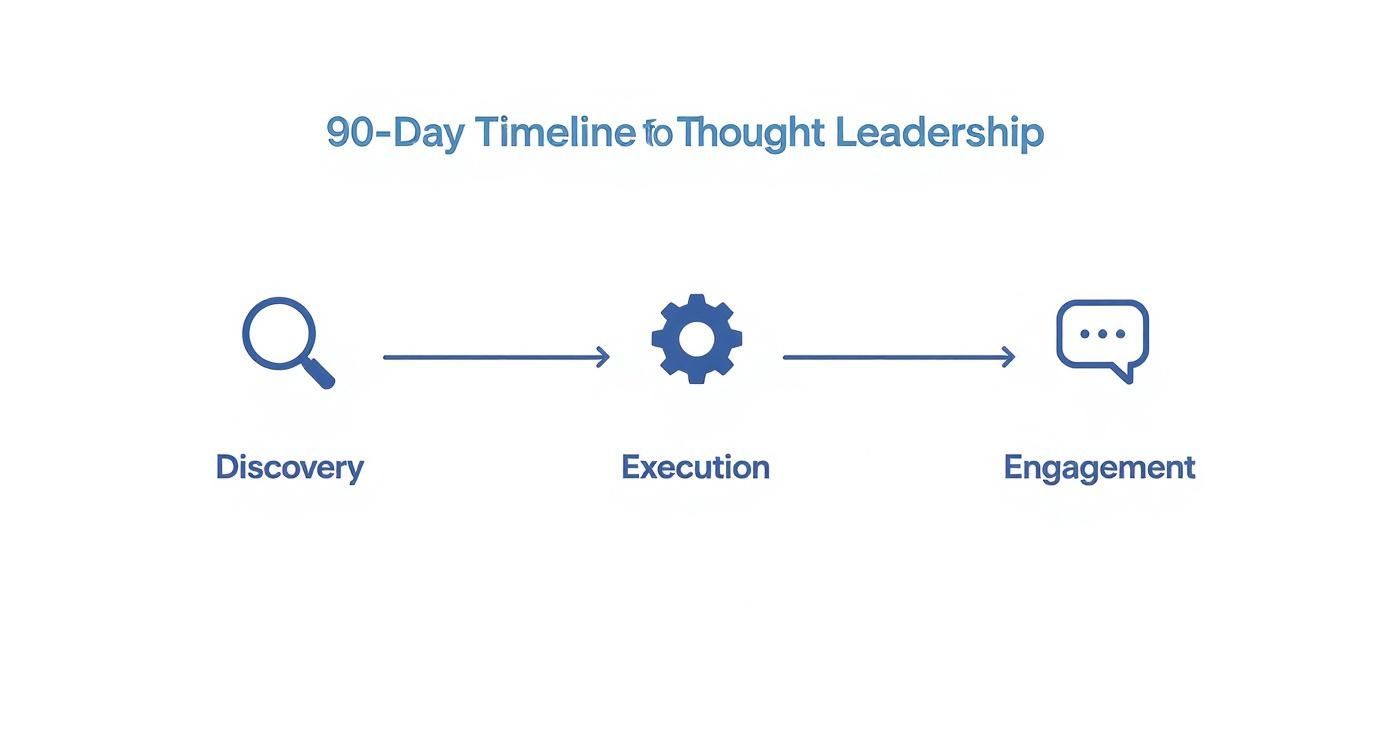
As you can see, each phase builds directly on the last one. It’s all about steady, deliberate growth.
Weeks 5-8: The Execution Phase
With your strategy locked in, the next month is all about one thing: building a consistent content habit. The focus here is on process, not perfection.
Your objective is to establish a repeatable workflow that allows you to show up consistently. Consistency builds trust faster than anything else.
Your main job now is creating and scheduling content based on the ideas from your backlog. Commit to a realistic schedule you can actually stick to—starting with 3 times per week is a great goal. Use simple, affordable tools to help you turn one core idea into multiple post formats.
Start tracking early metrics like profile views and post impressions. This isn't about vanity; it's about getting a baseline so you know what's working.
Weeks 9-12: The Engagement Phase
The final month is where you amplify your efforts by building a community around your content. Pushing "publish" is only half the battle. The other half is joining the conversation.
Block out 20-30 minutes each day just for engagement. Drop thoughtful comments on posts from other key voices in your niche. And just as importantly, reply to every single comment on your own content.
Now, look at your first two months of data. Which content pillars got the most traction? What formats performed best? Use those insights to sharpen your strategy for the next 90 days.
Sample 90-Day Thought Leadership Sprint
Here’s a high-level look at what this all looks like in a simple table, breaking down the key activities and goals for your first three months.
| Phase (Days) | Focus | Key Activities | Success Metric |
|---|---|---|---|
| Days 1-30 | Discovery & Foundation | Define niche, POV, content pillars. Optimize LinkedIn profile. | Clarity on your unique, ethical angle and a fully optimized profile. |
| Days 31-60 | Execution & Consistency | Create & schedule content 3x/week. Establish a repeatable workflow. | A consistent posting habit is formed and maintained. |
| Days 61-90 | Engagement & Iteration | Daily engagement (20-30 mins). Analyze content performance. | Meaningful conversations started and a data-informed plan for the next quarter. |
This sprint provides the structure, but your consistency is what will bring it to life. Stick with it, and you'll be amazed at the progress you can make in just three months.
Common Questions on Getting Started
Diving into thought leadership always brings up a few nagging questions. "Am I ready for this?" "Where do I even start?" Let's clear the air and tackle some of the most common hurdles I see people face.
How Much Time Do I Really Need to Commit?
This is a big one. It's easy to assume you need to block out huge chunks of your week, but that’s not the case. The real secret isn't intensity; it's consistency.
You can make a serious impact with just 3-5 hours per week. That’s enough time to create one solid piece of content, break it down into smaller posts for the week, and jump into a few relevant conversations each day. Once you get your rhythm, you'll be surprised how efficient you become.
What If I Don’t Feel Like an "Expert" Yet?
Honestly, this is the thought that stops most people before they even start. But here’s the thing: "expert" is a totally relative term. You don't need to be the #1 authority in the world on a topic.
You just need to know a bit more than the audience you're trying to help. Or maybe you just have a different way of looking at things they haven't considered. Frame it as documenting your journey and sharing what you learn as you go. People connect with authenticity far more than they do with a flawless, authoritative voice.
Should I Be on Every Social Media Platform?
Please don't. That's the fastest way to burn out and see mediocre results everywhere. It's so much more powerful to go deep and really own one channel than it is to spread yourself thin across five.
Figure out where your target audience hangs out—for most B2B founders, marketers, and professionals, that’s going to be LinkedIn. Get really good at it. Once you've built a solid system and a real community there, then you can think about branching out.
How Do I Know If Any of This Is Actually Working?
In the beginning, you have to resist the urge to look for huge, game-changing results. Instead, focus on the small signals that tell you you're moving in the right direction.
Here are the leading indicators to watch early on:
- Engagement Rate: Are people actually stopping to comment, share, or react? That's your first clue.
- Profile Views: Is your content making people curious enough to click on your profile and see who you are?
- Conversation Quality: Are you getting into real, meaningful discussions in the comments or your DMs? This is where the magic happens.
The bigger stuff—like inbound leads and new business opportunities—will come later. Those are lagging indicators. First, you have to nail the fundamentals.
Ready to build your thought leadership presence on LinkedIn without the burnout? Contentide helps you turn your ideas into high-performing posts in minutes. Try it for free today at https://contentide.com and start publishing consistently.
Hope you found this helpful. Feel free to share your thoughts.