What Is Content Marketing? Your Guide
What is content marketing? Learn how to build trust and grow your business with this practical guide to creating valuable, ethical, and affordable content.

Forget shouting ads on a street corner. Imagine, instead, you decided to build a helpful community library. That's the real heart of content marketing. It’s a long-term strategy centered on creating and sharing genuinely valuable, free content to build relationships and earn trust. Instead of pitching products, you're offering solutions.
Understanding Content Marketing

At its core, content marketing flips the script from interruption to attraction. Think about a typical TV commercial—it interrupts your show to push a message you didn't ask for. Content marketing is the exact opposite. It's about providing the very information your ideal audience is already searching for, positioning you as a helpful guide, not a pushy salesperson.
This entire strategy is built on a principle of generosity. When you consistently offer real value through your articles, videos, or social media posts, you build a rock-solid foundation of trust. Over time, this makes your business a credible authority people choose to follow.
The Core Philosophy Behind It
The central idea is simple: if your business consistently delivers valuable information, your audience will eventually reward you with their business and loyalty. It's a marathon, not a sprint. You're nurturing relationships, making it a much more ethical and affordable way to grow. This approach respects your audience's intelligence, empowering them with knowledge so they feel confident in their decisions.
The goal isn’t to close a sale; it’s to open a relationship. By giving value upfront without expecting an immediate return, you create a magnetic pull that draws the right people to you.
This philosophy has become a cornerstone of modern business. Its adoption has skyrocketed, proving just how effective it is. As of 2025, an incredible 91% of global brands say they use content marketing. In North America, that number climbs even higher, with 94% of marketers weaving content into their strategies. You can dig deeper into these content marketing statistics to see the full picture.
What It Looks Like In Practice
So, how does this actually work day-to-day? Instead of an ad screaming, "Buy Our Blenders!", a blender company might create a series of fun recipe videos or a helpful guide on picking the best smoothie ingredients. It’s all about meeting people where they are with content that actually serves their needs.
Here are a few common ways this comes to life:
- Answering Questions: Writing blog posts that directly address the most common frustrations and questions your potential customers are Googling right now.
- Providing Solutions: Publishing practical how-to guides, tutorials, or webinars that help people solve a real problem, showcasing your expertise in the process.
- Building Community: Using platforms like LinkedIn to share industry insights, start meaningful conversations, and connect with other professionals.
So, what is content marketing, really? It's the art of communicating with your customers without the hard sell. It’s non-interruption marketing that provides so much value, you earn—not buy—your audience's attention.
Content Marketing vs Traditional Advertising
To really understand the shift, it helps to see the two approaches side-by-side. The differences are pretty stark.
| Aspect | Content Marketing (Ethical & Affordable) | Traditional Advertising |
|---|---|---|
| Approach | Pulls the audience in with valuable information. | Pushes messages out to a broad audience. |
| Goal | Build trust, relationships, and long-term loyalty. | Generate immediate sales and brand awareness. |
| Audience | A specific, targeted group actively seeking solutions. | A general, often passive audience. |
| Communication | Two-way dialogue; fosters community and conversation. | One-way monologue; brand speaks at the audience. |
| Value | The content itself is the value. | The value is in the product being advertised. |
| Longevity | Assets build value over time (evergreen content). | Campaigns are short-lived and require constant budget. |
Ultimately, while traditional ads rent attention, great content owns it. It becomes a lasting asset for your business.
Why Content Marketing Actually Works
Let's be honest, most marketing feels like renting. You pay for an ad, it runs for a bit, and then it's gone. Content marketing is different. It’s about building something you own, an asset that works for you long after you've published it.
Think of it like this: ads are like buying bouquets of flowers—they look great for a few days, but then you have to buy more. Content is like planting a garden. Each helpful article or insightful video is a seed that can grow, attract visitors, and generate leads for years. It’s an incredibly smart, sustainable way to grow a business by actually helping people first.
Building Trust Before You Ask for the Sale
Nobody likes being sold to. We’re all tired of intrusive ads and pushy sales pitches. Content marketing flips that entire dynamic on its head by building a bridge of trust first.
When you consistently put out valuable content—answering questions, solving problems, offering new perspectives—you become a credible authority. You're not asking for anything, you're just giving.
So, when the time comes for a customer to make a purchase, who do they think of first? Not the stranger with the flashy ad, but the trusted guide who has already helped them. You've shifted from a salesperson to a respected expert.
True influence is built on trust, not transactions. Content marketing allows you to earn that trust by demonstrating your expertise and genuine desire to help your audience succeed. This shifts the dynamic from persuasion to partnership.
This isn’t just feel-good stuff; it drives real business results. That trust fuels brand awareness, generates qualified leads, and fosters the kind of loyalty that keeps customers coming back. You’re not just collecting clicks; you're building a community.
An Affordable Engine for Growth
From a purely financial standpoint, the numbers don't lie. Paid ads demand a constant stream of cash to stay visible. Content is an asset that appreciates over time. The effort you put into one great article today can pay you back for months, even years, as it climbs search rankings and gets shared.
The data backs this up. Studies consistently show that content marketing costs 62% less than traditional outbound marketing while generating over three times as many leads. It's no surprise that 90% of businesses now use content in their campaigns. For a deeper dive into the numbers, you can check out more on the effectiveness of content marketing strategies.
The real magic here is organic search. By creating content that directly answers the questions your audience is typing into Google, you attract highly motivated visitors for free. This dramatically lowers your customer acquisition costs. You can find many more insights on building a powerful content strategy over on the Contentide blog.
Connecting With Your Audience on a Deeper Level
At the end of the day, the true value of content marketing is its ability to create real human connections. It’s your chance to:
- Educate and Empower: Give your audience the tools and knowledge they need to make smarter choices.
- Establish Authority: Become the first name people think of in your industry because you consistently share your expertise.
- Foster Loyalty: Build a genuine following that sticks around because you provide real, consistent value.
This isn't just another marketing tactic. It's a long-term commitment to serving your audience, and it creates a powerful, self-sustaining system that drives real, lasting business growth.
Choosing Your Content Formats and Channels
Once you've bought into the idea of building trust by being genuinely helpful, the next question is always, "Okay, but what do I actually create?" This is where you pick your tools.
Choosing the right content formats and channels is like a chef selecting the right knives for a specific dish. Each one has a purpose, and using the right one makes all the difference.
Your goal isn't to become a master of everything at once. The smartest approach is to start small. Pick just one or two formats that play to your strengths and match what your audience actually wants. Get really good at those before you even think about expanding.
Matching Formats to Your Strengths and Goals
Every format has its own superpower. Blog posts are absolute workhorses for building long-term search engine authority and answering your customers' most pressing questions. Video, on the other hand, creates an immediate human connection, while podcasts are perfect for building intimacy with an audience that's always on the move.
The real key is aligning the format with your business goals. Are you just trying to get your name out there? Or are you focused on generating leads? Maybe you need to educate existing customers? Each goal has a format that works best.
This simple flowchart breaks down how your main goal—whether it's awareness or leads—should guide your starting strategy.
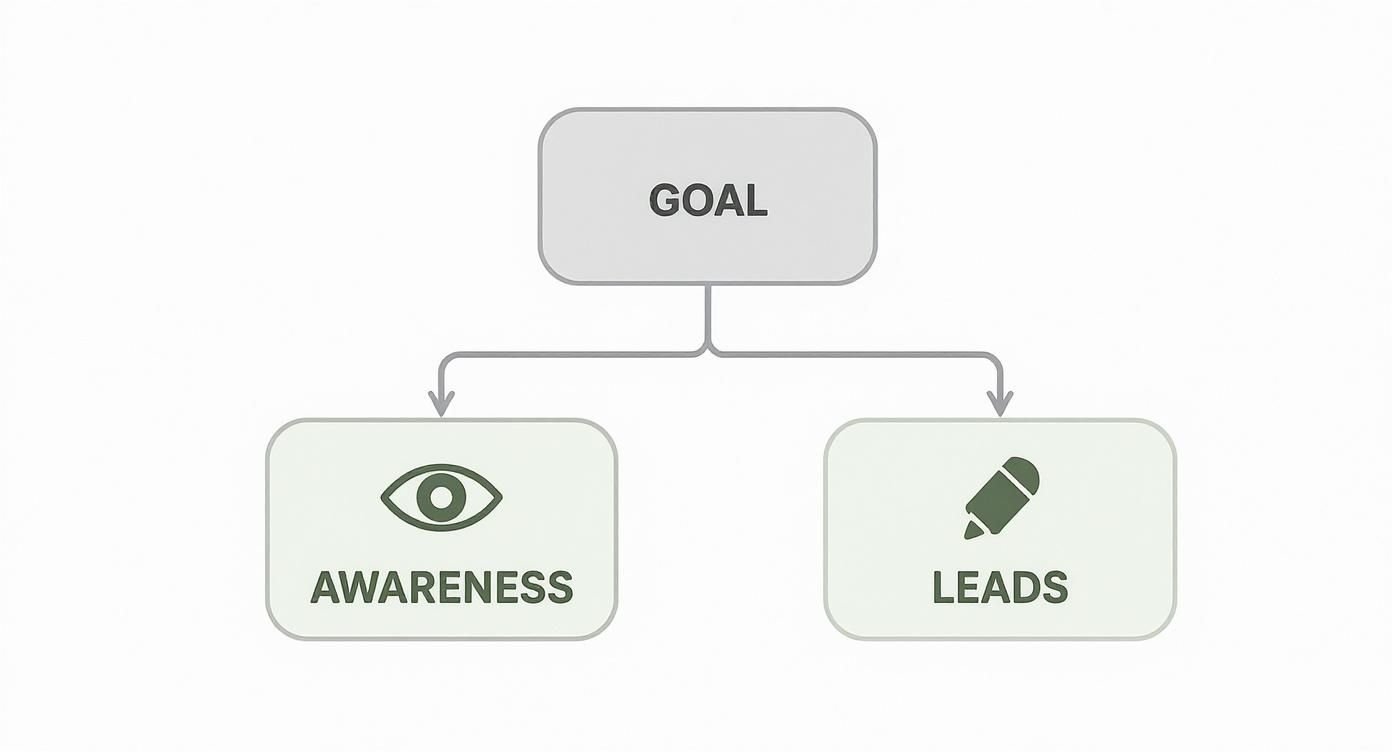
As you can see, your core objective points you directly toward the kind of content that will get you the best results, faster.
The Most Effective Content Formats
Let’s break down some of the most powerful and accessible formats. And remember, you don't need a Hollywood production budget to get started.
Blog Posts and Articles: For many, this is the cornerstone of content marketing. Written content is cost-effective, fantastic for search engine optimization (SEO), and perfectly positions you as a helpful expert. A great place to start is simply by answering the questions your customers ask you every day.
Video Content: Whether it's a quick clip for social media or a detailed tutorial on YouTube, video excels at showing, not just telling. It's incredibly engaging and can make complex ideas feel simple. Honestly, your smartphone is probably all you need to begin.
Podcasts: Audio creates a deep, personal connection with listeners. It's a brilliant format for interviews, storytelling, or sharing industry insights with busy professionals who can listen during their commute.
Infographics: These are your secret weapon for making complex data easy to digest and incredibly shareable. They're perfect for breaking down stats, processes, or comparisons into a format that’s easy on the eyes.
The best format is the one you can consistently create at a high level of quality. It’s better to produce one excellent blog post per week than to produce a mediocre post, video, and podcast episode each month.
To make your written content even more powerful, you have to grab attention from the very first word. A strong opening is everything, which is why using a good hook generator can be a huge help in crafting introductions that stop the scroll and keep people reading.
To help you decide, here’s a quick guide that connects common business goals to the content formats that can get you there.
Choosing The Right Content Format For Your Goal
| Business Goal | Primary Content Format | Secondary Content Format | Key Channel |
|---|---|---|---|
| Build Brand Awareness | Short-Form Video | Blog Posts | Social Media, YouTube |
| Generate Leads | Webinars, Ebooks | Case Studies | Email, LinkedIn |
| Educate Customers | How-To Articles, Tutorials | Video Walkthroughs | Blog, Help Center |
| Establish Authority | In-Depth Guides, Reports | Podcasts, Interviews | Website, LinkedIn |
This table isn't a rigid set of rules, but it's a solid starting point for mapping your goals to a realistic content plan.
Choosing Your Distribution Channels
Creating great content is only half the job. You also have to get it in front of the right people. The channel you choose is just as important as the format itself.
Think of your own website or blog as your home base—it's the one piece of digital real estate you completely own and control. But to reach a wider audience, you have to distribute your content on other platforms where people are already hanging out.
For countless professionals, founders, and consultants, LinkedIn is the place to be. It’s evolved far beyond a job board; it's a powerhouse for sharing expertise, building your personal brand, and connecting directly with peers and potential clients. Sharing insightful articles, text posts, or video clips there can quickly establish you as a go-to voice in your industry.
Other vital channels include:
- Email Newsletters: The best way to speak directly to your most engaged audience.
- YouTube: The world's second-largest search engine, making it a must for video.
- Social Media (X, Instagram, etc.): Great for building community and engaging in real-time conversations.
The secret? Start with just one or two channels where you know your target audience is most active. Learn the platform, build a rhythm, and master it before you spread your efforts too thin.
How to Build Your Content Strategy From Scratch

A powerful content marketing strategy isn’t some complex flowchart or expensive software subscription. It’s your roadmap. It’s a simple, ethical guide that takes you from understanding who you're talking to all the way to delivering real value. This plan makes sure every bit of effort is focused, consistent, and built for the long haul—even if you're working with a tight budget.
Think of it like building a house. You wouldn’t just show up with a hammer and start nailing boards together. You’d figure out who’s going to live there, what they need, and how to build something that’s actually useful and sturdy. Your content strategy does the exact same thing, turning random acts of content into a focused engine for your business.
Let's walk through a clear, six-step framework to build your plan from the ground up.
Step 1: Pinpoint Your Audience and Goals
Before you write a single word, you have to know who you’re talking to and what you’re trying to achieve. Get this right, and everything else becomes ten times easier and more effective. It's the most critical step, period.
Start by sketching out a simple buyer persona—a fictional profile of your ideal customer. What are their biggest professional headaches? What questions keep them up at night? An ethical strategy demands you genuinely understand their problems so you can provide real solutions, not just more noise.
Next, set clear, measurable goals. Vague targets like "get more traffic" are totally useless. You need specific outcomes:
- Awareness: Increase organic search traffic by 20% in the next quarter.
- Engagement: Boost the average time on page for our blog posts to over three minutes.
- Conversion: Generate 50 new email subscribers per month from our free guide.
These concrete numbers become your North Star, guiding every single content decision you make from here on out.
Step 2: Discover Relevant Topics and Keywords
Now that you have a clear picture of your audience and goals, it’s time to figure out what they're actually searching for. This is where keyword research comes in, but don't let that term intimidate you. The whole idea is just to find the exact phrases people type into Google when they need the answers you can provide.
Your secret weapon here is long-tail keywords. These are longer, more specific phrases like "how to write a LinkedIn post for sales" instead of a broad term like "LinkedIn." They have way less competition and attract a much more motivated audience.
Content marketing succeeds when you stop creating what you want to say and start creating what your audience wants to find. Your strategy is the bridge between your expertise and their needs.
You can uncover these topics by simply brainstorming common customer questions, browsing forums like Reddit or Quora, or using affordable keyword tools. The goal is to build a solid list of content ideas that directly tackle your audience's biggest pain points.
Step 3: Create a Simple Content Calendar
Consistency is the engine of content marketing. A content calendar is the key that turns it on. This doesn't need to be some fancy, expensive software. A simple spreadsheet or a Trello board works perfectly.
Your calendar just maps out what you'll publish, when you'll publish it, and where you'll share it. This simple act of planning gets rid of the last-minute scramble and ensures a steady, reliable stream of value for your audience. A good calendar includes the topic, target keyword, format (e.g., blog post, video), and publication date for each piece.
Step 4: Produce and Distribute Your Content
Okay, now it's time to create. Focus on producing high-value, ethical content that genuinely helps your audience. Whether it’s a blog post, a short video, or a helpful infographic, your number one goal should always be to solve a problem or answer a question better than anyone else.
But creating great content is only half the battle. You have to promote it. Once you hit publish, share your work on the channels where your audience actually spends their time—especially platforms like LinkedIn for professional audiences. Repurpose your main content into smaller pieces, like turning a blog post into a series of social media tips, to get more mileage without starting from scratch.
Step 5: Track Your Results and Adjust
Finally, remember that a strategy isn't set in stone; it's a living document. You have to track your progress against the goals you set back in step one. Use free tools like Google Analytics to keep an eye on key metrics like organic traffic, time on page, and conversion rates.
This data tells you what’s working and what isn’t. Maybe you'll find your audience loves your how-to guides but completely ignores listicles. By reviewing your performance regularly, you can make smart, data-informed tweaks—doubling down on what resonates and refining your approach for even better results. To stay competitive, leveraging intelligent tools has become essential. You can explore the Top 12 AI Tools For Content Marketing In 2025 to help streamline both your creation and distribution efforts.
Measuring the Metrics That Actually Matter
If you don't measure your content's performance, you’re just creating content for the sake of it. It’s like flying blind. Measuring what you create is the only way to know if you're actually providing value, and honestly, it’s the cheapest way to get better. It forces you to look past empty "vanity metrics" and focus on the data that leads to smarter decisions.
Digging into your analytics isn't about getting lost in spreadsheets. It’s about asking one simple question: "Is this working?" The answer is right there in the key performance indicators (KPIs) tied directly to your business goals. This is a core part of what content marketing is—a feedback loop that helps you serve your audience better over time.
Focusing on Awareness Metrics
Awareness metrics tell you how many people are discovering your brand through your content. Think of these as top-of-funnel signals showing if you're successfully reaching new audiences.
The big one here is organic traffic. This is the number of visitors who find you through a search engine like Google without you paying a dime for ads. A steady climb in organic traffic is a huge sign that your content is hitting the mark and your SEO efforts are paying off.
Other key awareness metrics include:
- Impressions: The total number of times your content was shown to someone, whether in a search result or a social feed.
- Backlinks: The number of other websites linking to your content. This is a massive vote of confidence in the eyes of search engines.
Tracking Crucial Engagement Metrics
Once people find your content, are they actually sticking around? Engagement metrics answer that question by showing you how people interact with what you’ve built. This is where you find out if your content is genuinely interesting.
A critical metric to watch is time on page. This tells you the average amount of time a visitor spends reading a specific post. If people are spending several minutes on a long article, you’ve clearly created something helpful.
The most honest feedback you'll ever get isn't in the comments section—it's in the data. High engagement shows your content is solving a real problem for your audience.
Also, keep an eye on social shares. When someone shares your post on a platform like LinkedIn, they are putting their own reputation on the line and vouching for its quality. It’s one of the clearest signals you’ve made something worth their network’s attention.
Measuring Conversion and Business Impact
At the end of the day, content marketing has to contribute to the bottom line. Conversion metrics are where the rubber meets the road, showing you how well your content persuades readers to take a specific, valuable action.
The most common conversion goal is a newsletter sign-up or a lead generation form completion. Every time someone gives you their email in exchange for a guide or a webinar, your content has successfully turned a passive reader into an engaged contact.
Other vital conversion metrics are:
- Click-Through Rate (CTR): The percentage of people who click a specific link in your content, like a call-to-action button.
- Downloads: How many times users download a resource you've offered, like a template or an ebook.
Analyzing these different layers of data gives you a complete picture of your content’s real-world impact. For a deeper dive, you can explore resources on how to measure content performance effectively. By focusing on these numbers, you can stop guessing and start building a strategy that delivers genuine results.
Common Content Marketing Mistakes to Avoid
Learning from what doesn't work is one of the cheapest ways to get ahead in content marketing. If you can sidestep a few common pitfalls, you’ll save yourself a ton of time, money, and frustration. Most strategies that fall flat don’t fail because the core idea was bad; they fail because of a few critical, and totally avoidable, errors.
The biggest mistake I see? Creating content that's all about you. Your audience doesn't want another sales pitch disguised as a blog post. They’re online because they have a real problem and are looking for a real solution. When your content just drones on about product features, you push away the very people you’re trying to attract.
The fix is to adopt an ethical, audience-first mindset. Before you write a single word, ask yourself: "What problem does this solve for my reader?" Every single piece of content should be built to serve their needs first, not your promotional goals.
Ignoring SEO and Promotion
Another classic blunder is the "publish and pray" approach. You can write the most brilliant, insightful article in the world, but if nobody can find it, it delivers zero value. Skipping basic SEO is like building a beautiful library but forgetting to install any doors—it’s full of incredible information that no one can access.
And just hitting "publish" isn't the finish line. Failing to promote your content is a massive missed opportunity.
Content marketing success is often determined after you hit publish. A great piece of content with poor distribution will always underperform an average piece with excellent distribution.
You don’t need a huge budget to get this right. Just follow these simple steps:
- Basic SEO: Weave relevant keywords naturally into your titles, headings, and body text.
- Active Promotion: Share your content where your audience actually hangs out, like on professional networks such as LinkedIn.
- Repurposing: Turn one big blog post into five smaller social media updates. This extends its reach and gives you more chances to connect.
Giving Up Too Soon
Finally, so many businesses quit right before they start seeing results. Content marketing isn't like paid ads that give you an instant (but temporary) hit of visibility. It's a long-term investment. Building trust with an audience and authority with search engines takes time and consistency. Expecting overnight success is a surefire recipe for disappointment.
The key here is patience. Content marketing delivers compounding returns; an article you publish today could be attracting new leads for years to come. Commit to a consistent schedule, keep an eye on your progress, and trust the process. By steering clear of these common mistakes, you’ll be on your way to building a resilient and powerful content engine that works for you around the clock.
Your Content Marketing Questions Answered
As you start mapping out your content marketing plan, a few practical questions always pop up. Getting straight answers can be the difference between moving forward with confidence and feeling stuck. Let's tackle the big ones.
How Much Should a Small Business Budget for Content?
There isn't a magic number, but a good rule of thumb is to set aside somewhere between 10% and 30% of your overall marketing budget for content.
For a small business, this doesn't have to mean a huge cash spend right away. Your most valuable investment at the start is your own time—or a team member's—dedicated to creating genuinely helpful material. You can get pretty far with free tools for research and analytics. The key is to treat content like a core part of your business, not just an afterthought.
How Long Does It Really Take to See Results?
Look, content marketing is a long game. It's a marathon, not a sprint. While a single post might get a quick burst of attention on social media, the real, compounding value—like building a steady stream of organic search traffic—takes time to kick in.
You should expect to see meaningful results within six to nine months of consistent effort. We're talking noticeable bumps in website traffic, more leads coming in, and a real sense of authority in your space. Patience is everything; quitting after three months is like pulling your money out of an investment before it has a chance to grow.
The exact timeline can shift depending on how competitive your industry is and how consistently you're putting out high-quality stuff. A steady rhythm will always beat short, intense flurries of activity followed by radio silence.
Can I Do This All on My Own?
Absolutely. Plenty of successful founders and solo entrepreneurs run their own content marketing, especially when they're just starting out. The secret is to start small and stay focused. Don't burn yourself out trying to launch a blog, a podcast, and a video series all at once.
Pick one format you're comfortable with—like writing insightful articles on LinkedIn—and get really good at it. Once you build some momentum, you can start branching out. For more answers to questions like these, you can find a ton of info by checking out our Contentide FAQ page. The most important thing is to just start sharing what you know.
Ready to stop staring at a blank page and start building your authority on LinkedIn? Contentide helps busy professionals create authentic, high-performing posts in minutes. Turn your ideas into polished content and grow your network with ease. Try Contentide for free today!
Hope you found this helpful. Feel free to share your thoughts.