How to Get LinkedIn Connections That Matter
Learn how to get LinkedIn connections the right way. Our guide covers profile optimization, smart outreach, and ethical strategies to grow your network.

Before you send a single connection request, we need to talk about your profile. It's the first thing anyone sees, and getting it right is non-negotiable. Think of it as your digital storefront—if it's messy or incomplete, people will walk right by.
Your profile works for you 24/7, so let's make sure it's making a great first impression. This isn't about vanity; it's about turning a passive page into an active networking machine that makes people want to connect with you based on your authentic professional story.
Build a Profile People Actually Want to Connect With
You wouldn't invite guests over to a messy house, right? The same logic applies here. A weak profile suggests you don't pay attention to detail, which is the last message you want to send.
The goal is to build a clear, compelling narrative that communicates your value, expertise, and a bit of your personality. It's the single most effective (and affordable) thing you can do to kickstart your networking.
Craft a Headline That Communicates Value
Your headline is the most important piece of real estate on your entire profile. It follows you everywhere—in search results, comments, and every connection request you send. Don't just settle for your job title.
Instead, describe the value you create.
- Generic: "Marketing Manager at ABC Corp"
- Value-Driven: "Driving B2B Growth Through Data-Driven Content Marketing | SEO & Demand Generation Specialist"
See the difference? The second one immediately tells a potential connection what you do, who you help, and the skills you bring to the table. If you're feeling stuck, a good headline generator can give you some solid, affordable starting points.
This simple workflow breaks down the three pillars of a profile that gets results: a sharp headline, a professional photo, and a well-defined skills section.
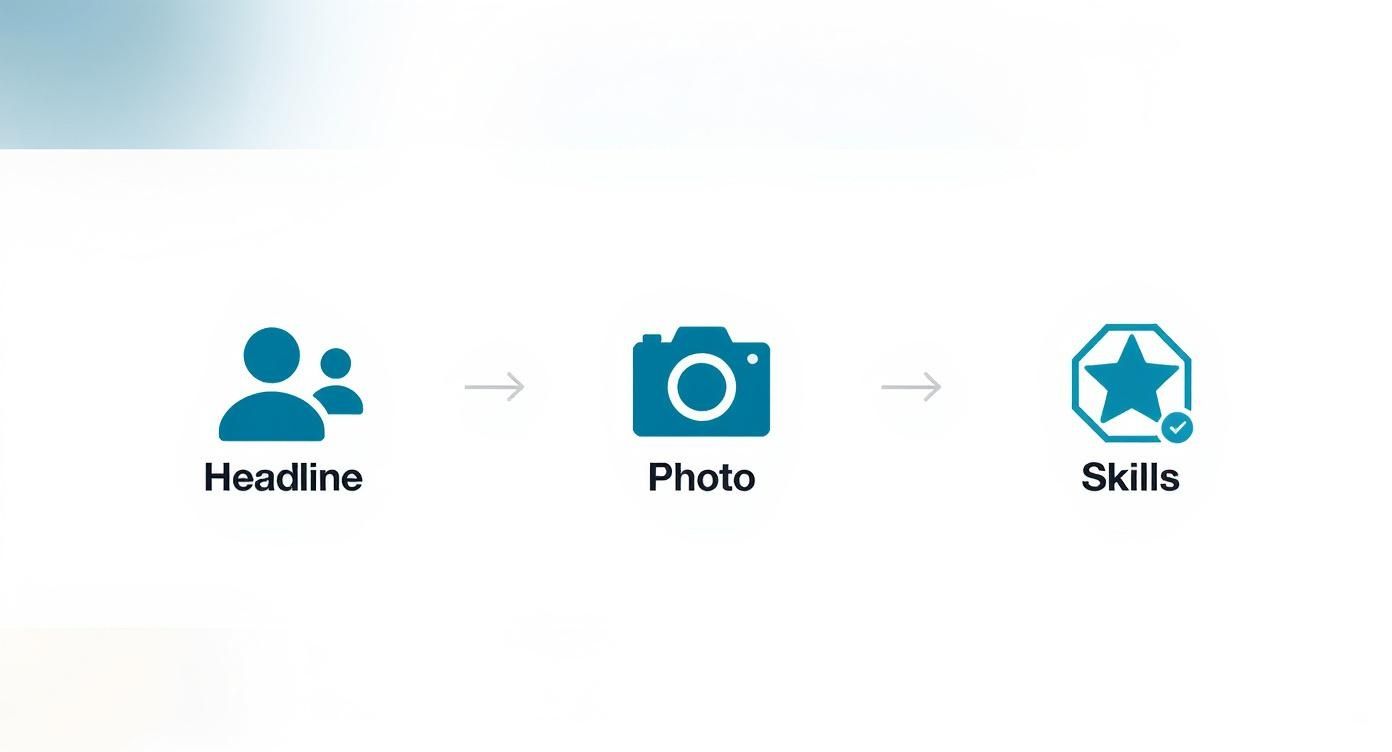
When these three elements work together, they create a flywheel effect, pulling in more views and, ultimately, more of the right connections.
Optimize Your Photo and Banner
First impressions are almost always visual. Your profile picture needs to be a professional, high-quality headshot where you look friendly and approachable. No vacation photos, blurry selfies, or group shots. Period.
Pair that with a custom banner image that reflects your personal brand or your company. It’s a simple, free way to stand out from the sea of default blue backgrounds.
Your LinkedIn profile is your digital handshake. Make it firm, confident, and memorable by ensuring every section works together to tell a cohesive professional story.
Tell Your Story in the Summary and Skills Sections
Your "About" section is where you get to tell your story. Don't just copy-paste your resume. Explain your professional journey, what you're passionate about, and what drives you. Use short paragraphs and bullet points to keep it scannable.
Finally, fill out your skills section. This is huge. LinkedIn's own data shows that profiles with at least five skills get up to 17 times more profile views. More visibility means more inbound connection requests and opportunities knocking on your door. An optimized profile is the foundation for everything that follows.
Craft Connection Requests That Get Accepted
Once your profile is polished and ready to go, the real work begins: outreach. Let's be honest, sending that default “I’d like to connect with you on LinkedIn” message is a massive missed opportunity. It’s the digital equivalent of walking up to someone at a conference, handing them your card without a word, and just walking away. Awkward, right?
Effective outreach boils down to one thing: personalization. It’s about showing you’ve done a tiny bit of homework and see the other person as more than just another number for your network. This isn't just better etiquette; it's a more ethical and effective way to build genuine relationships.
The trick is to find one small piece of common ground. That simple act makes your request feel genuine, respectful, and builds a real foundation from the very first touchpoint.
Find the Right People to Connect With
Before you can personalize a message, you have to find the right person. LinkedIn’s search tools are incredibly powerful for this, even on the free plan. Don't just search for a job title and call it a day—get specific.
You can slice and dice your search by:
- Industry: Find professionals in sectors that actually matter to your goals.
- Company: Target people at specific organizations you admire or want to work with.
- Location: Build your local network by searching for folks in your city or region.
- Shared Groups or Schools: This is a goldmine. Finding common ground with alumni or peers who share your interests is the easiest warm intro you can get.
Combining these filters lets you build hyper-targeted lists, which makes the next step—personalization—feel natural instead of forced.
Personalize Every Single Request
A personalized note is your secret weapon for boosting your acceptance rate. I've seen it time and time again: a tailored message blows a generic one out of the water. While the average acceptance rate for broad outreach campaigns hovers around 29.61%, a quick, relevant note can easily push that number toward 45%.
Your note doesn’t need to be an essay. Please, don't write an essay. Two or three sharp sentences are all you need to establish why you're reaching out.
The goal of a connection request is not to make a sale or ask for a job. It is simply to open the door for a future conversation by showing genuine, specific interest in the other person.
This is where that common ground comes into play. Mentioning a shared connection, a recent post they wrote, or that you both attended the same webinar makes all the difference.
Use Proven Templates as a Starting Point
Having a few templates on hand can speed things up without making you sound like a robot. The trick is to treat them as frameworks, not scripts. Always swap in the key details for the specific person you're contacting. If you're struggling with that first sentence, you could even get some ideas from a hook generator to make your opener more compelling.
Here are a few templates I’ve seen work really well in different situations.
Effective LinkedIn Connection Request Templates
The key to a good template is leaving a clear, designated spot for genuine personalization. Here’s a look at how that plays out in a few common scenarios.
| Scenario | Template Example | Key Personalization Point |
|---|---|---|
| Industry Peer | "Hi [Name], I came across your profile and was really impressed with your work in [their specific project or skill]. I’m also in the [your field] space and would love to connect with fellow professionals. Looking forward to following your work." | Mentioning a specific piece of their work shows you actually looked at their profile. |
| Post-Event | "Hi [Name], I really enjoyed your insights on [Topic] during the [Event Name] webinar today. Your point about [specific takeaway] was particularly interesting. I'd love to connect and keep learning from you." | Citing a specific point they made proves you were paying attention and valued their contribution. |
| Alumni Connection | "Hi [Name], I saw that we both attended [University Name]. Go [Mascot]! I'm currently working in [Your Industry] and would appreciate the chance to connect with a fellow alum in the field." | The shared university is the opener, but mentioning your industry adds relevant context. |
| Mutual Connection | "Hi [Name], I see we're both connected with [Mutual Connection's Name]. I'm looking to expand my network with experts in [their field], and your profile stood out. Would be great to connect." | Naming the mutual connection immediately establishes a layer of trust and familiarity. |
Each of these examples is brief, specific, and gives a crystal-clear reason for connecting. This simple approach respects the other person's time and dramatically increases the odds they’ll click "Accept."
Warm Up Your Network Before You Connect
Sending a connection request out of the blue is a lot like asking a stranger for a favor. It might work, but the odds are definitely not in your favor. A much smarter (and more ethical) approach is to warm up your potential connections before you even think about hitting that button.
This simple shift in strategy changes the entire dynamic. You go from being an unknown interruption in their notifications to a welcome, familiar face.
The goal here is to build familiarity first. When your name has already popped up in their notifications in a positive way, your eventual connection request feels like the natural next step, not some random, self-serving solicitation.
And the best part? This doesn’t require expensive tools or complicated systems. It just takes a few moments of genuine engagement. It’s about showing you’re interested in their insights, not just in boosting your connection count.
Engage Before You Request
Think of it as a multi-touchpoint approach. Before sending that request, you want to interact with their content or activity on LinkedIn at least two or three times over a week or two. This consistent, low-pressure engagement is what builds the rapport you need for them to happily click "Accept."
This method absolutely pays off. People who like, comment, or share posts from potential connections before reaching out see a 20-30% higher acceptance rate compared to those sending completely cold requests. Engagement builds a bridge of trust. You can find more details on these LinkedIn engagement statistics on Buffer.com.
So, what does this actually look like in practice? It's simpler than you might think.
- Like Their Posts: This is the easiest first step. A simple "like" on a recent post or article they shared gets your name on their radar with zero friction.
- Leave Thoughtful Comments: This is where you can really stand out. Don't just drop a "Great article!" Add to the conversation. Ask a follow-up question, share a related insight, or agree with a specific point they made.
- Share Their Content: If they post something genuinely valuable, share it with your own network and be sure to tag them. This is a huge signal that you not only value their content but want others to see it, too.
A Practical Warm-Up Sequence
To make this super actionable, here’s a simple sequence you can follow. Treat this as a flexible guide, not a rigid formula, for building authentic familiarity.
Follow Them First: Instead of jumping straight to the connect button, just click "Follow" on their profile. This lets you see their content in your feed without asking for anything in return.
Week 1 - First Touch: Find a recent post and leave a relevant, thoughtful comment that adds to the discussion. For example, if they post about a marketing trend, you could comment, "This is a great point about AI's role. I've seen similar results when applying it to [your specific experience]. Have you found that to be the case as well?"
Week 1 or 2 - Second Touch: A few days later, find another piece of their content to engage with. This could be a simple "like," or even better, share their post with a comment like, "Excellent insights here from [Name] on the future of remote work. Well worth the read."
Send the Personalized Request: Now that you’ve established a bit of a presence, it’s time to send your connection request. The key is that your personalized note can now reference your previous interactions, making it feel warm and contextual.
"Hi [Name], I've really been enjoying the content you've been sharing about [their topic]. Your recent post on [specific article] was especially insightful. I'd love to connect and continue following your work."
This approach respects their space and demonstrates genuine interest. It turns a cold outreach into a warm introduction, which is a far more effective (and ethical) way to grow a network of meaningful connections.
Create Content That Pulls Connections to You
Outreach is a great way to get started, but the real endgame is having high-quality connections come to you. This shift happens when you stop being just another profile and start becoming a valuable voice in your industry. The best way to do that? Create simple, consistent content.
You don't need a fancy camera or a design degree. Seriously. The whole point is to share what you already know in a way that helps your target audience solve a problem, learn something new, or just see a familiar challenge from a different angle.

When you show up consistently with valuable insights, people will naturally want to join your network to see more. This inbound approach builds a network of people who are genuinely interested in what you have to say.
Find Your Content Sweet Spot
The biggest hurdle for most people is just figuring out what to talk about. The answer is usually hiding in plain sight—it's the knowledge you use every single day in your job.
Think about it. What questions do your clients always ask? What problems is your team constantly solving? These are perfect topics because they're pre-validated; you already know people are looking for answers.
Here are a few simple but powerful formats to get you started:
- Insightful Text Posts: Share a personal story, a lesson you learned from a recent project, or your take on an industry trend. Keep it short and focus on one single takeaway.
- Simple Polls: Ask a question tied to a common pain point in your industry. This is a low-effort way to kick off conversations and gauge what your audience cares about.
- Helpful Carousels: Break down a complex idea into a few simple, visual slides. You can whip these up with free tools, and they're incredibly shareable.
The goal isn't to go viral. It's to be helpful. Consistently sharing your expertise establishes you as a credible authority, which is a magnet for connection requests.
Share Your Expertise with Generosity
Once you have some ideas, the trick is to frame them in a way that provides immediate value. To really draw people in, you need to understand how consistent, strategic content can blow up your profile's visibility. In fact, there's even a proven 30-day plan for posting on LinkedIn that shows just how impactful this can be.
For example, instead of just dropping an opinion, explain the "why" behind it.
- Weak Post: "I think companies should focus more on employee retention."
- Strong Post: "High employee turnover costs way more than you think. We recently cut our churn by 15% just by implementing a simple mentorship program. Here's the three-step framework we used..."
See the difference? The second example gives the reader a concrete idea they can actually use. This generous sharing of knowledge is what turns passive scrollers into active followers and, eventually, valuable connections.
Your LinkedIn content is your professional generosity at scale. When you give away your knowledge freely, you build trust and authority that attracts opportunities and connections far more effectively than any cold outreach ever could.
Build Community in Your Comments
Posting the content is only half the battle. The real magic happens in the comments section. This is your chance to turn passive viewers into an active community.
Make it a non-negotiable to respond to every single comment, especially within the first few hours. Acknowledge the person, answer their question, and ask something to keep the conversation going. This doesn't just signal to the algorithm that your post is engaging; it shows everyone that you're an approachable professional who's actually listening.
When people see you actively building a community, they’ll want to be part of it.
Scale Your Networking Efforts Ethically
Let's be real: growing your network manually is a serious time sink. But scaling up doesn't mean you have to resort to spammy, impersonal tactics that everyone hates.
You can get a lot more efficient while keeping your approach professional and ethical. The trick is to streamline the repetitive parts of the process while doubling down on the human touch where it matters most—personalization.
This is all about smart efficiency, not cutting corners on building actual relationships. Plenty of affordable and safe tools can help you manage your outreach without getting you flagged by LinkedIn or trashing your reputation. It's about finding that sweet spot that lets you connect with more of the right people without sacrificing quality.
This balanced approach is how you grow a quality network efficiently without compromising your professional integrity.
Know What to Automate and What to Personalize
Think of your networking workflow in two parts: tasks a machine can handle, and interactions that absolutely must be human. Trying to automate a genuine conversation is where most people go wrong, and it’s why our inboxes are full of generic messages we instantly ignore.
Here’s a simple breakdown of what’s safe and smart to streamline:
- Profile Vetting: Tools can help you sift through search results much faster to build a high-quality list of potential connections.
- Follow-Up Reminders: Instead of trying to remember who you need to message next from a messy spreadsheet, you can set up systems to ping you.
- Content Scheduling: Planning and scheduling your posts ahead of time saves a ton of mental energy and keeps you consistent.
The golden rule of scaling is simple: Automate the process, not the personality. Your unique voice and genuine interest are your greatest assets. You can't outsource them to a bot.
Stay Within Safe Limits
LinkedIn is always on the lookout for spammy behavior, and they have limits on daily and weekly activity. They don't publish the exact numbers, but a solid rule of thumb is to keep your daily connection requests under 20-25.
This pace shows you're focused on quality, not just blasting out requests to anyone and everyone, which helps keep your account in good standing.
To really manage this effectively, exploring the best LinkedIn automation tools can be a game-changer. Just make sure you choose affordable tools that are designed to work within LinkedIn's guidelines and prioritize the safety of your account.
Ethical scaling is about using technology to assist your genuine networking efforts, not replace them. Set realistic daily goals, focus on authentic interactions, and you can grow your network efficiently without raising any red flags.
Common Questions About Growing Your LinkedIn Network
As you start putting these strategies into action, you're bound to run into a few practical questions. It happens to everyone. Getting the nuances right is what separates sustainable growth from spammy tactics that get your account flagged.
Here are some straightforward answers to the questions I hear most often. Think of this as your guide to being both smart and respectful as you build your network.
How Many Connection Requests Can I Send?
LinkedIn keeps the official weekly invitation limit under wraps, and honestly, the exact number seems to shift. But chasing the maximum limit is the wrong game to play anyway. The real goal is building genuine relationships, and that means prioritizing quality over quantity.
I've found that sending 15-20 highly personalized connection requests per day is the sweet spot. It's a sustainable pace that lets you maintain a high acceptance rate and build a network of people who actually matter to your career, not just a list of random names.
What Is the Best Way to Follow Up?
Getting someone to accept your request is just the first step. The follow-up is where the real work—and the real opportunity—begins. Don't let that new connection go cold.
The most valuable connections are the ones you nurture. A simple, timely follow-up message turns a notification into a conversation, laying the groundwork for a real professional relationship.
Try to send a brief follow-up message within 24 hours of connecting. A simple "thanks for connecting" is fine, but you can do better. The goal is to start a real conversation. Mention something you genuinely appreciate about their work or ask a thoughtful, open-ended question about their industry. It’s all about building rapport, not jumping straight into a sales pitch.
Should I Focus on Network Size or Relevance?
This one's easy, but it’s probably the most important question of all. The answer is crystal clear: a smaller, highly relevant network will always be more valuable than a massive, disconnected one.
Think about it. Who would you rather have in your corner? A thousand engaged professionals in your specific industry, or ten thousand random contacts who don't know you and don't care what you do?
- A Quality Network: Full of people in your industry, your target audience, or adjacent fields you admire.
- The Likely Outcome: More engagement, better opportunities, and actual professional relationships.
- The Strategy: Be selective. Focus every connection request on people who align with your professional goals.
When you put quality first, your network's value grows right alongside its size.
Ready to create compelling content that pulls connections to you? Contentide helps you generate authentic, high-performing LinkedIn posts in minutes, so you can focus on building relationships. Start publishing consistently and grow your network at https://contentide.com.
Hope you found this helpful. Feel free to share your thoughts.